How to Measure a Gambrel Roof for Metal Roofing
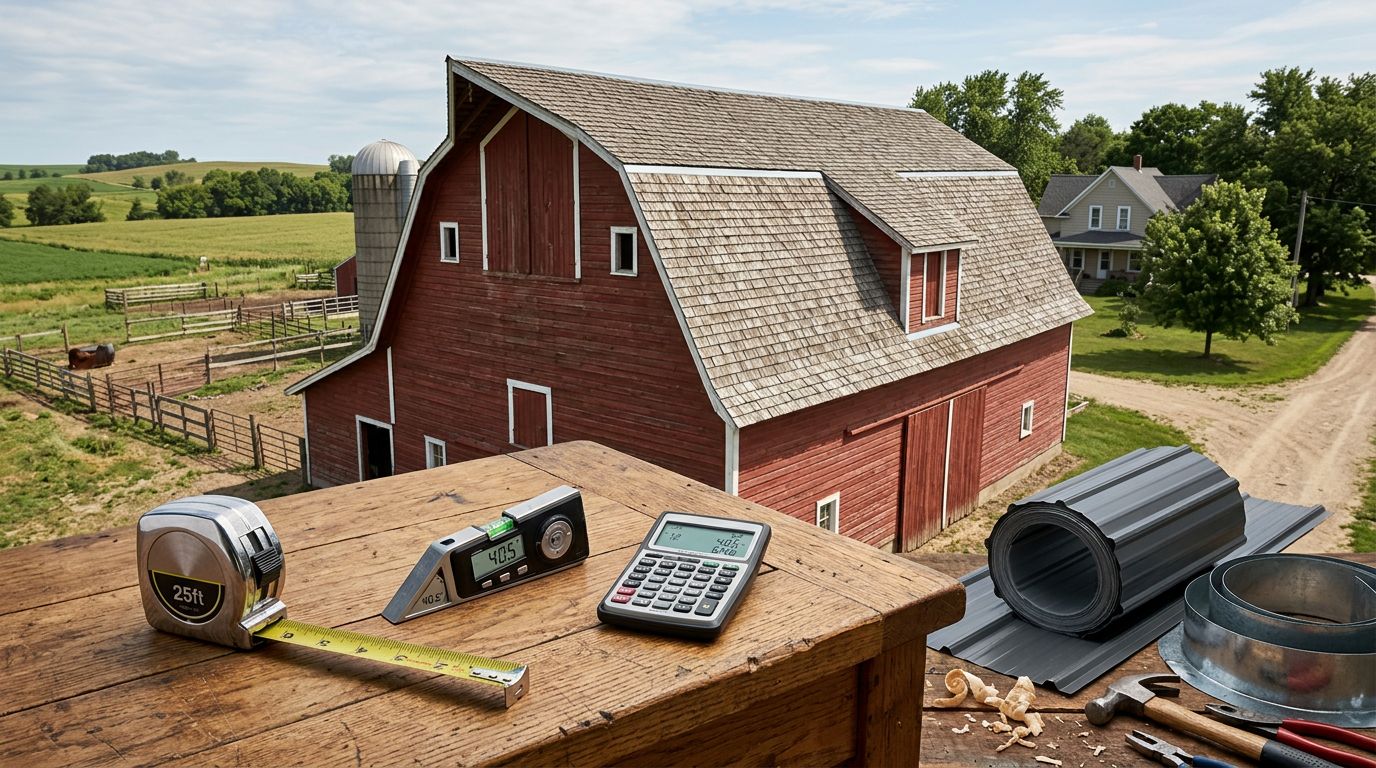
A gambrel roof can fool you from the ground. It looks simple, but each side has two slopes, and each slope changes the takeoff.
That extra break in the roof line matters when you order metal panels, trim, and flashing. If you measure it like a basic gable roof, the numbers can come up short fast.
The safest approach is to treat each roof plane as its own measurement and build the estimate from there.
Start with a roof sketch and the right measurements
Before you pick up the calculator, draw the roof shape. Label the four planes, lower left, upper left, lower right, and upper right. Mark the ridge, the change in pitch, and every overhang.
If you have measured other metal roofs before, the same careful takeoff method used in measuring roof for metal panels still applies here. The difference is that a gambrel roof has a second slope on each side, so one line on the sketch never tells the whole story.
Use a tape measure, pitch gauge or level, notepad, and calculator. If the roof is steep or slippery, stay on the safe side and measure from the ground, a ladder, or a secure access point.
A clean sketch keeps the math honest. It also helps you spot the parts of the roof that need trim, flashing, or extra cuts.
| Measurement | What to record | Why it matters |
|---|---|---|
| Roof length | Eave-to-eave length along the building | Panel length and ridge or eave trim |
| Lower run | Horizontal distance from eave to the break in slope | Lower plane area |
| Upper run | Horizontal distance from the break to the ridge | Upper plane area |
| Rise for each slope | Vertical height of each plane | Sloped width and pitch |
| Overhang | Eave and gable projection | Trim, drip edge, and panel length |
Use the actual roof dimensions, not the footprint alone. A gambrel roof always covers more surface than the flat outline below it.
Measure each gambrel plane separately
The best way to measure a gambrel roof is one plane at a time. That means measuring the lower slope and upper slope on one side, then repeating the process on the other side.
- Measure the roof length along the eave or ridge line, depending on the panel direction.
- Measure the lower slope's horizontal run and rise.
- Measure the upper slope's horizontal run and rise.
- Repeat the same steps on the opposite side, unless you have confirmed the roof is perfectly symmetrical.
Each slope is its own plane, so each slope deserves its own line on the takeoff sheet.
For each plane, use this formula:
Area of one plane = roof length x sloped width
If you know the run and rise, use the diagonal formula:
Sloped width = square root of (run x run + rise x rise)
That matters because the surface length is longer than the horizontal run. On a roof, that difference adds up.
For example, say the roof is 36 feet long. The lower plane has a 4-foot run and a 3-foot rise, so the sloped width is 5 feet. The upper plane has an 8-foot run and a 4-foot rise, so the sloped width is about 8.9 feet. One side totals about 503 square feet, and a matching opposite side brings the roof to about 1,006 square feet before waste.
If the two sides do not match, measure both sides. Do not copy one side's numbers and hope they line up later.
Turn roof area into panels, trim, and flashing
Once you know the total surface area, you can estimate panels. Still, panel count is only part of the order. You also need to account for the profile you choose, the trim package, and the way the roof breaks at the change in pitch.
Start with the panel's net coverage width , not its full sheet width. A panel that looks like 16 inches wide on paper may cover less after side laps or seam design are counted. Use the coverage number from the product details.
Then check panel length by plane. On a gambrel roof, the lower and upper slopes may need different panel lengths. A fixed-length panel might work on one plane and waste material on the other. Cut-to-length panels often fit this shape better.
Add material for these items before you finalize the order:
- Rake trim on both gable edges.
- Eave trim or starter strip along the lower edges.
- Ridge cap at the top of the roof.
- Transition flashing or custom trim at the change in pitch, if the system calls for it.
- Side laps and end laps when the panel profile or length requires them.
- Waste from cuts, test pieces, damaged panels, and layout changes.
If you need help matching the trim to the panel profile, choosing metal roof rake trim is a useful next step. Gambrel roofs have plenty of gable edge, and the trim has to fit the panel, the fascia, and the slope angle.
For the break between the lower and upper slopes, do not guess on the flashing. Some systems use a formed transition piece. Others use custom trim made to the roof profile. That detail should be part of the takeoff, not an afterthought.
A full roof count should reflect the actual installation, not just the panel field. The trim package often decides whether the order is complete or short.
Common mistakes that throw off gambrel roof estimates
A gambrel roof creates more ways to miss a measurement than a simple gable roof. The errors are common, but they are easy to avoid.
- Measuring only the footprint leads to a short order. The roof surface is larger than the building outline.
- Combining both slopes into one number hides the break in the roof and throws off panel length.
- Using the same measurement for both sides can create problems if the framing is not perfectly even.
- Confusing nominal width with coverage width makes the panel count look better than it really is.
- Forgetting trim at the gables, ridge, and break line leaves you with panels but no way to finish the roof cleanly.
- Skipping waste is risky on a roof with extra cuts and short upper-plane panels.
Florida roofs add another layer of pressure because wind, water, and heat punish weak details. That makes a careful takeoff even more important. If the panel choice, trim layout, or flashing detail needs a refresher, metal roof flashing and trim installation tips can help connect the measurement to the install.
A gambrel roof may look repetitive, but the slope break changes the whole order.
Waste is the last number to add, not the first. Many estimators start around 10% for a clean, symmetrical gambrel roof. Add more when the roof has short runs, lots of penetrations, or a panel layout that forces extra cuts.
Do not forget small roof openings either. Pipes, vents, and similar penetrations usually need flashings and sealant details, so they belong in the accessory count. They rarely reduce your panel total enough to matter.
Conclusion
A gambrel roof gets easier to measure when you stop thinking of it as one roof. Each side has two planes, and each plane needs its own measurement, area, and panel count.
Once you use the real sloped dimensions, the right coverage width, and a separate allowance for trim, flashing, overlap, and waste, the estimate starts to match the roof in front of you.
That's the part that keeps a metal roofing order on track, especially when the roof has more breaks than it first appears.
Share Our Metal Roofing News Articles
Related Posts