How to Diagnose Metal Roof Panel Backfeed Leaks
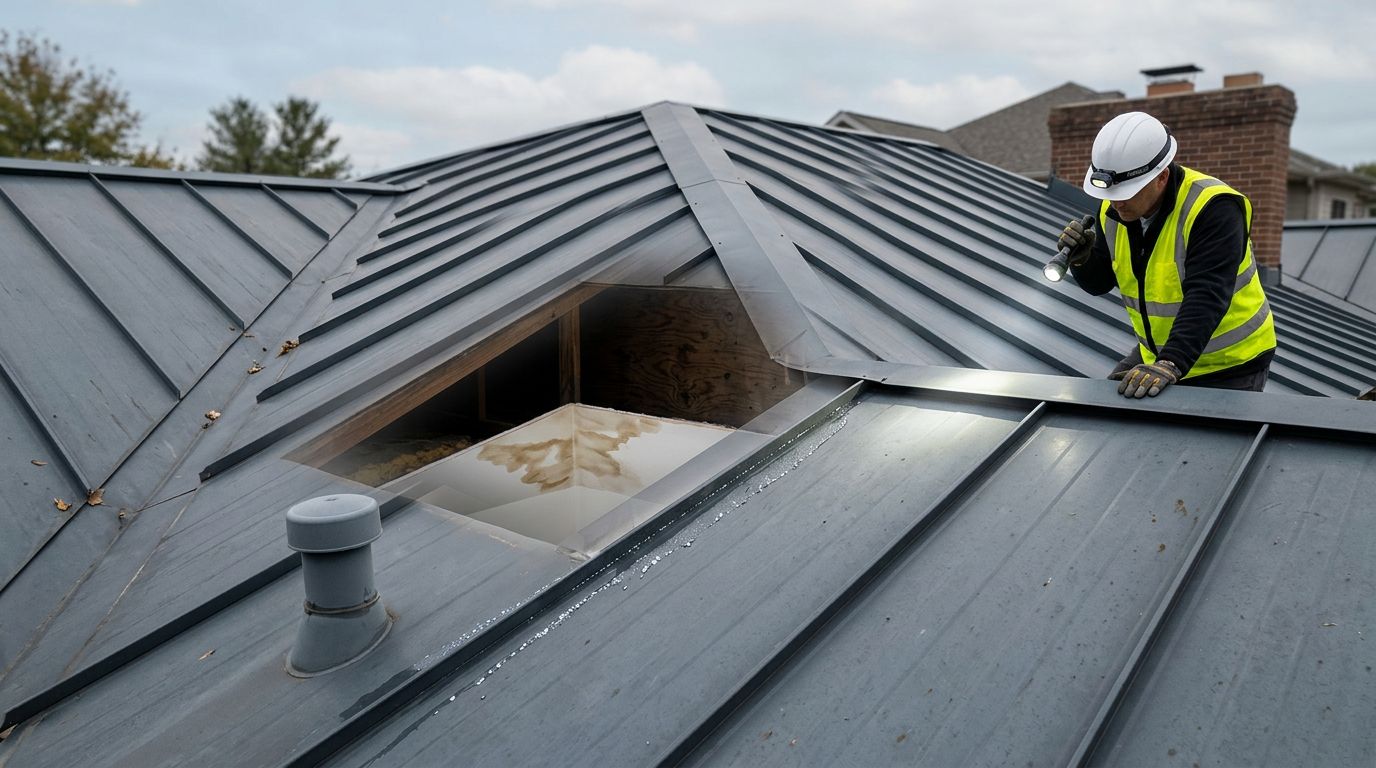
Water that shows up below a metal roof panel often did not enter there. It may have moved uphill under a seam, lap, or flashing before it finally dripped inside.
That is why metal roof backfeed leaks can waste time and money. A stained ceiling does not always point to the source, especially after Florida wind-driven rain.
Start with the path water could have traveled, then compare the symptom to common look-alike problems. The right diagnosis cuts the repair down to size.
What panel backfeed leaks look like
Backfeed happens when water enters a metal roof higher up, then follows a hidden path before it appears inside. That path can run under a rib, behind trim, beneath a lap, or along a flashing edge. On a dry day, the stain may seem random. During a storm, the same spot can soak again.
The clue is often location. A leak can show up several feet below the actual entry point. It can also appear near a wall, a ridge, or the inside corner of a room instead of under the most obvious panel seam.
A stain marks the end of the water path, not always the start.
On panel roofs, that difference matters. Wind can push rain sideways. Capillary action can pull water into tight gaps. Poor laps or missing closures can let water move where it should not. If the roof is newer or recently repaired, compare what you see against the metal roofing installation instructions before you guess at the cause.
A practical inspection sequence
A good inspection follows the water, one step at a time. Start inside, then move outward and uphill.
- Map the inside damage first. Note the exact ceiling spot, wall line, or corner. Look for water tracks, insulation staining, and fastener rust nearby.
- Match the leak to the weather. Backfeed often shows up after wind-driven rain, not every shower. If the roof stays dry during calm rain, that clue matters.
- Work uphill from the stain. Check the panel seams, ribs, and trim above the wet spot. Water usually enters higher than the visible damage.
- Compare the panel layout to the original detail. Fastener rows, lap spacing, and closure placement should match the intended design. If they do not, review the metal roofing installation instructions before assuming the leak is elsewhere.
- Inspect every transition. Pay close attention to ridges, sidewalls, end laps, valleys, and roof openings. Those points create the best conditions for backfeed.
- Document before changing anything. Photos, tape marks, and notes help you avoid chasing the wrong spot after the first repair.
The goal is to find a pattern, not a single wet mark. Once you know the pattern, the likely entry point becomes much easier to isolate.
Common look-alikes that mimic backfeed
A leak path can look the same from the attic, but each problem leaves different clues. The table below helps separate them fast.
| Look-alike issue | What you might see | What usually gives it away |
|---|---|---|
| Fastener leak | Small wet spots near screw lines or panels | Loose screws, failed washers, or visible rust at fasteners |
| Penetration leak | Water near vents, pipes, or curbs | Moisture centered around one opening |
| Condensation | Broad dampness, fog, or wet insulation | Moisture appears without rain, often in humid or poorly vented spaces |
| End-lap problem | Leak below a panel overlap | Staining follows a seam line, often after strong wind |
| Ridge or capillary action | Water near the top of the roof | Gaps at closures, ridge trim, or rib ends |
| Wall and flashing transition | Stains that start beside a wall | Damage appears where the roof meets vertical surfaces |
The biggest clue is pattern. Fastener and penetration leaks stay local. Backfeed usually travels.
Fasteners and penetrations
Loose fasteners often create small, direct leaks. They are common near screw lines, but the stain usually stays close to the problem. A backed-out screw, cracked washer, or missing seal at a pipe boot gives the game away faster than a backfeed leak does.
Penetrations act the same way. Vents, exhausts, skylights, and curbs leak near the opening, not far away. If the wet area sits below a vent but not around it, keep looking uphill for a seam or flashing issue.
Condensation
Condensation gets blamed often because it can look like a roof leak. In Florida, humid air and temperature swings can leave moisture on the underside of metal panels, decking, or insulation. That moisture may spread across a broad area instead of tracing a clean line.
Rain history helps here. If the wetness appears on dry days, or if several spots feel damp without matching a storm pattern, condensation moves higher on the list. Poor attic airflow, missing vapor control, and air leaks from the building below can all feed the problem.
End laps and ridge areas
End laps are a classic backfeed point on long panel runs. Water can sneak between sheets if the lap detail is short, misaligned, or missing sealant where the system calls for it. Once water gets in, gravity does not always win right away. Wind and panel geometry can carry it farther than expected.
Ridge areas can behave the same way. Open rib ends, weak closures, or gaps in ridge trim let water and wind work together. That is why a stain near the top of a roof deserves extra attention, even when the ceiling damage shows up much lower.
Wall and flashing transitions
Sidewalls, headwalls, chimneys, and curb flashings are frequent trouble spots because they mix horizontal and vertical surfaces. Water can enter behind the flashing, then travel along the roof line before it drops inside. A sealant bead may hide the symptom for a while, but it does not fix a bad termination.
When a stain starts near a wall, compare the detail with troubleshooting metal roof flashing leaks. That helps separate a backfeed path from a wall transition failure, which need different repairs.
Diagnostic mistakes that send repairs the wrong way
A leak that looks simple can get expensive when the diagnosis is lazy. These mistakes show up often:
- Recaulking the stain instead of the source. Sealant can hide the clue without fixing the entry point.
- Testing on a dry day and calling it done. Some leaks only appear with wind, angle, or heavy runoff.
- Trusting one wet spot. Water can travel under panels and show up far from the entry point.
- Assuming all roof moisture is a leak. Condensation can mimic storm damage, especially in humid buildings.
- Replacing fasteners before checking transitions. A wall, lap, or ridge issue can be the real cause.
Repair work goes faster when the source is clear. Guessing usually adds more holes, more sealant, and more confusion.
When professional leak testing is the right move
Professional leak testing makes sense when the source stays unclear after a solid inspection. It also helps when the roof has multiple possible entry points, such as several penetrations, long panel runs, or layered flashing details.
A trained roofer can use controlled water testing, moisture mapping, or other field methods to isolate the path. That matters on large roofs, steep roofs, and roofs with concealed insulation, where the stain tells you very little. It also matters after storm damage, when one problem can hide another.
Safety should decide part of the answer too. Wet metal, tall roofs, and slick slopes raise the risk fast. If you cannot inspect from a safe position, or if the leak keeps returning after patch work, bring in a professional who can test without turning the problem into a fall hazard.
Conclusion
Backfeed leaks are hard because the water does not always drip where it enters. The stain is only the last stop on the path.
A careful inspection starts inside, moves uphill, and compares the symptom against fasteners, penetrations, condensation, end laps, ridges, and flashing transitions. That order keeps you from patching the wrong place.
When you focus on the water path , the roof starts making sense. That is the difference between a fast fix and a repair that holds.
Share Our Metal Roofing News Articles
Related Posts