Metal Roof Underlayment Types for Florida Heat and Humidity
Florida sunshine can be tough on a roof, but the real trouble often starts under the metal. When heat, humidity, and wind-driven rain team up, the wrong underlayment can wrinkle, dry out, trap moisture, or fail fast.
If you're choosing metal roof underlayment Florida homeowners can trust, focus less on the brand name and more on the performance numbers. Service temperature, UV exposure limits, vapor permeability, and wind-uplift details matter because they decide whether your roof stays dry during a storm and stays stable during summer heat.
Below is a practical breakdown of underlayment types and how to pick one that fits your roof style and location.
Why Florida's climate makes underlayment selection trickier
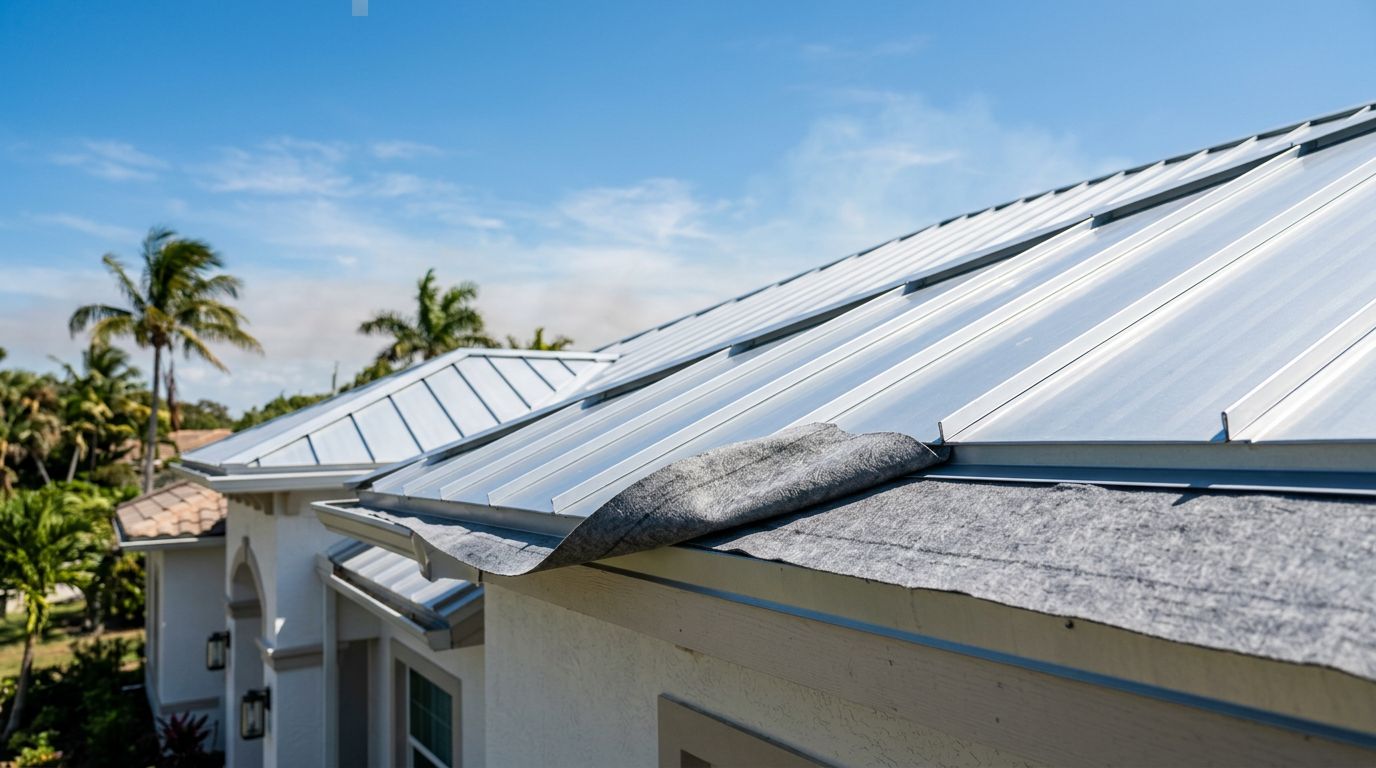
Think of underlayment like a raincoat under armor. Your metal panels block most water, yet underlayment handles what sneaks past laps, trim, and fasteners during heavy rain and high winds. In Florida, it also has to survive extreme deck temperatures and long stretches of humid air.
Here are the selection factors that matter most in this state:
- Service temperature rating : Metal panels can drive very high surface temperatures. If the underlayment softens, it can creep, split, or lose adhesion. For many Florida installs, high-temperature rated products are worth the upgrade.
- UV exposure limits : Jobs get delayed. Some underlayments tolerate sun exposure for weeks, others degrade quickly. Always match the product's UV allowance to your schedule, not your best-case plan.
- Vapor permeability vs. condensation control : Permeable underlayments can help the roof assembly dry. On the other hand, the wrong "breathable" choice won't fix condensation caused by air leaks and cold surfaces. If you're chasing mystery moisture, start with a clear diagnosis (this guide on metal roof condensation in Florida causes and fixes lays out the usual culprits).
- Wind-uplift and water backup : Underlayment should stay put in high winds and resist wind-driven rain. In HVHZ areas (Miami-Dade and Broward), code requirements often push you toward fully adhered membranes and sealed deck approaches, not basic mechanically fastened sheets.
A simple rule holds up in real Florida weather: if the roof could see wind-driven rain, your underlayment should act like a backup roof, not just a slip sheet.
Underlayment types that work under metal roofing in Florida
Most Florida metal roofs use one of three categories: synthetic sheets, high-temp self-adhered membranes, or felt. Felt can still be allowed in many cases, but it's usually the weakest choice for heat and humidity.
This table gives a quick side-by-side view.
| Underlayment type | What it does well in Florida | Common watch-outs under metal |
|---|---|---|
| Synthetic (mechanically attached) | Strong tear resistance, good walkability, often better UV tolerance than felt | Needs correct fastening pattern and overlaps, seams may need tape for "sealed deck" goals |
| High-temp self-adhered (peel-and-stick, rubberized asphalt) | Excellent water resistance, helps create a sealed secondary barrier, great for valleys, eaves, and high-risk zones | Higher cost, substrate prep matters, removal later is harder, choose a high-temp rated product for metal |
| Asphalt felt (#30, where permitted) | Low upfront cost, familiar install methods | Can wrinkle, absorb moisture, and break down faster in heat and humidity, lower tear strength in wind events |
A few compatibility notes that matter under metal panels:
- Standing seam systems often benefit from smooth, stable underlayments. Wrinkles and bubbles can telegraph into the finished roof on some assemblies.
- Exposed-fastener panels depend heavily on correct trim and closure details since wind-driven rain can travel up ribs. Underlayment is your backup when those details get tested.
- Fastener chemistry and corrosion resistance matter near the coast. Pair your underlayment plan with the right screws, washers, and sealants (see metal roofing fasteners and accessories to compare common options used with Florida metal panels).
Recommendations by scenario (coastal vs. inland, vented vs. unvented, new vs. re-roof)
Florida roofs don't all fail the same way, so the "best underlayment" depends on where the building sits and how the roof is built.
Coastal Florida (salt air, higher corrosion risk)
Coastal jobs reward simple, conservative choices.
A high-temp self-adhered membrane on the full deck is often the safest path when approvals allow it, especially in high-wind zones and complex rooflines. It helps block wind-driven rain if water gets past trim. Pair that with corrosion-resistant fasteners and plan your penetrations carefully.
Inland Florida (high heat, heavy rain, fewer salt issues)
Inland, a quality synthetic underlayment can perform very well, especially on straightforward roofs with good drainage. If you want better storm backup, many crews "upgrade the risky areas" by using self-adhered membrane at eaves, valleys, sidewalls, and penetrations, then synthetic on the field.
Vented attic assemblies (common in residential)
If your attic is vented and balanced, a more vapor-open synthetic can help the assembly dry, as long as you don't rely on it to solve condensation. Air sealing and duct leaks usually matter more than perm ratings once the AC runs daily.
Unvented or conditioned assemblies (spray foam, sealed attics)
Unvented designs can work in Florida, but they need a clear moisture strategy. In these cases, crews often lean toward self-adhered membranes that support sealed-deck performance, combined with correct insulation and air sealing so humid air does not reach cold surfaces.
New roof vs. re-roof (tear-off vs. overlay)
On a full tear-off, you can fix the deck, tighten attachment, and create a cleaner sealed deck. On overlays, details get harder.
If you're considering installing metal over existing shingles, read when a metal roof retrofit over shingles is allowed. Underlayment and separation layers have to match the approved assembly, not guesswork.
Standing seam vs. exposed-fastener panels
- Standing seam : prioritize high-temp ratings and a smooth substrate, because panel flatness shows. Also confirm clip and fastener compatibility with the underlayment system.
- Exposed-fastener : prioritize water management at laps, closures, and penetrations. Underlayment becomes your safety net when wind pushes water where it doesn't "normally" go.
If you want a quick code sanity check before ordering materials, this overview of Florida building codes for metal roofing is a helpful starting point for homeowners and contractors.
Quick checklist and questions to ask your roofer
Concise underlayment checklist (Florida-focused)
- Confirm the underlayment has Florida Product Approval , and if applicable, Miami-Dade NOA .
- Verify the service temperature rating is suitable for metal roofing.
- Check the UV exposure limit for your expected install timeline.
- Decide whether you need a sealed deck approach (taped seams or self-adhered).
- Match vapor permeability to the assembly (vented vs. unvented), and fix air leaks either way.
- Use corrosion-resistant fasteners and compatible sealants, especially near the coast.
- Confirm the system meets the required wind-uplift attachment schedule for your zone.
Questions to ask your roofer before you sign
- Which wind zone is this home in, and is it considered HVHZ ?
- What underlayment are you using, and what are its temp rating and UV limit ?
- Are you installing it as a sealed secondary water barrier or as a standard underlayment?
- How will you detail valleys, eaves, and penetrations to control wind-driven rain?
- What fasteners and washers are you using, and why are they a good fit for this location?
Conclusion
Florida metal roofing succeeds when the whole system works together, panels, trim, fasteners, ventilation, and underlayment . Start with the climate realities, then pick the underlayment type that matches your wind zone and roof assembly. When in doubt, spend money on the details that keep water out, because small failures under metal rarely stay small for long.
Share Our Metal Roofing News Articles
Related Posts