Metal Roof Ridge Cap Styles And When To Use Each
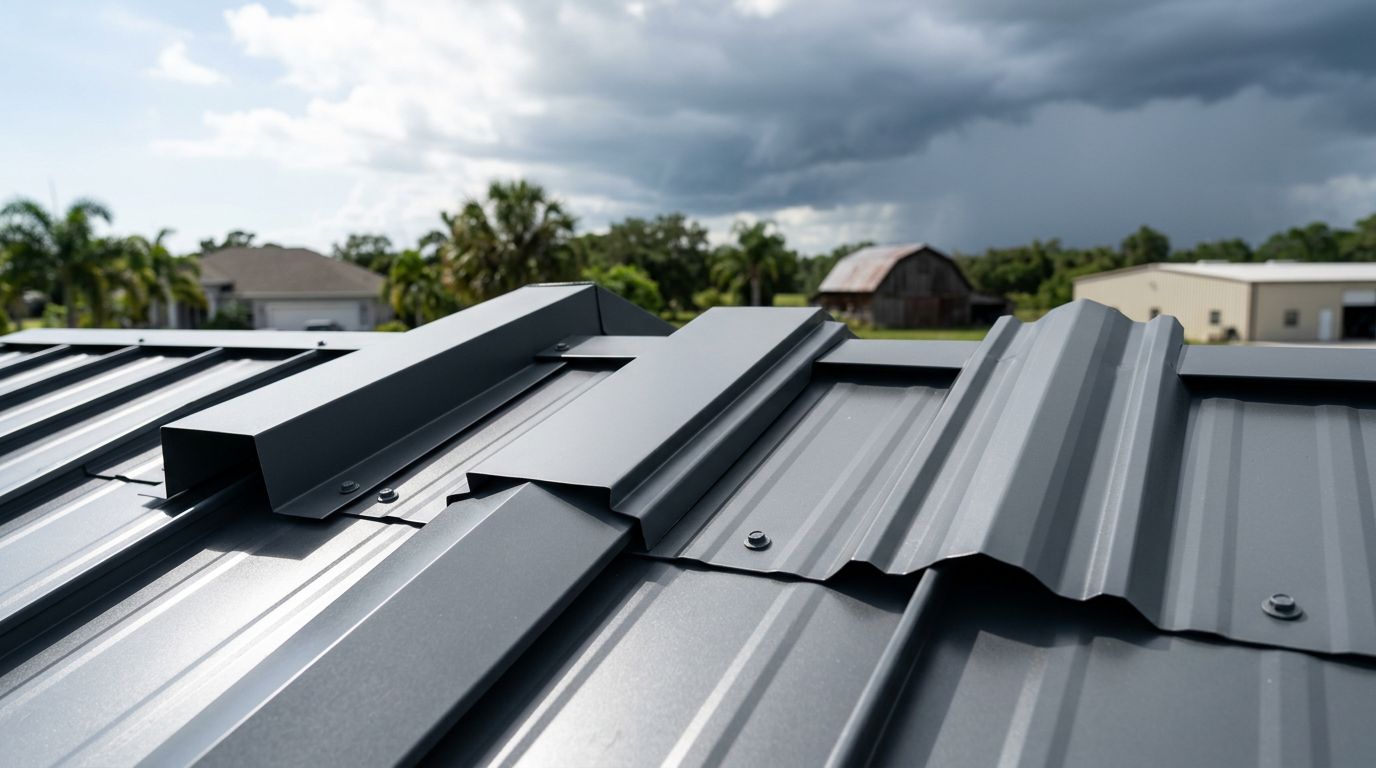
A ridge cap seems simple until the first Florida storm tests it. The ridge is the roof's highest seam, so it takes wind pressure, driving rain, and daily heat expansion all at once. If the metal roof ridge cap doesn't match the panel profile and the roof's venting plan, tiny gaps can turn into big problems.
This guide breaks down the most common ridge cap styles, what each one is best at, and how to choose the right setup for Florida homes, barns, and light commercial roofs. You'll also get a decision table and a few install do's and don'ts that prevent the usual ridge leaks.
What a metal roof ridge cap actually does (and why profile matters)
A metal roof ridge cap is the trim that covers the peak where two roof planes meet. Think of it like the lid on a storage tote. The tote can be tough, but the lid has to fit tight or water gets in.
A ridge cap has three jobs:
First, it keeps water out . Wind can push rain uphill, especially near the ridge where airflow speeds up. A good ridge detail blocks backflow while still letting the roof drain.
Next, it manages airflow when the attic is vented. A vented ridge cap lets hot, moist air exit at the peak. That only works if intake air can enter (usually at the soffits) and the ridge vent opening is sized and protected correctly.
Finally, it finishes the roof . Ridge caps cover cut panel ends and protect underlayment edges from UV.
The "fit" part matters more than people expect. Exposed-fastener panels (like Ag/Multi-Rib, PBR/R, and 5V) have ribs that create valleys and high spots at the ridge line. If you use a ridge cap that's too flat, it bridges over ribs and leaves voids. Those voids need the right closures (foam or metal) and sealant strategy, not extra screws.
If you want a quick refresher on trim names used on metal roofs (ridge, hip, valley, rake, eave), this plain-language guide helps: ridge cap, hip, valley trim basics.
Metal roof ridge cap styles, what they're for, and where they fail
Not every ridge cap is a "one size fits all" piece. These are the styles you'll run into most, plus when each one makes sense.
Standard (non-vented) ridge cap for exposed-fastener panels
This is the classic two-leg cap that overlaps both roof planes. It's common on Ag/Multi-Rib and PBR/R roofs where the attic isn't vented through the ridge, or where ventilation happens with other products (like gable vents or powered vents).
Use it when you want a simple, tight ridge and you can seal it with inside closures (foam that matches the panel ribs). In high-wind areas, this style works well when the cap has enough "drop" (leg length) to stay stiff and keep fasteners out of the highest turbulence zone near the peak.
Where it goes wrong: crews skip closures, rely on a fat bead of caulk, or run fasteners into the wrong spot on the cap. Florida wind-driven rain punishes those shortcuts.
Vented ridge cap (with vented closures or vent material)
A vented ridge cap looks similar from the ground, but it's built as part of an airflow system. Under the cap, the installer leaves a slot at the ridge, then uses a vented closure product (or vent strip) that blocks rain and bugs while letting air exhaust.
Choose a vented metal roof ridge cap when the building has soffit intake and you're trying to reduce attic heat and moisture. That matters in Florida, because trapped moisture can condense on cooler metal surfaces during temperature swings, especially after summer storms.
Watch-outs: ridge venting is not "add it anywhere." If the roof assembly is unvented by design (common on some conditioned attics), adding a ridge vent can create moisture problems instead of solving them.
High-rib ridge cap (built to clear taller ribs like PBR/R)
PBR/R panels have taller major ribs than many agricultural profiles. A high-rib ridge cap uses a taller "break" and often wider legs, so it sits down over the ribs without rocking.
Pick this style when the panel ribs are tall, the roof sees higher wind loads, or you want more room for closures and butyl tape. The extra height helps the cap stay rigid. It also reduces the temptation to overtighten screws to "pull it down."
Common mistake: using a low-profile cap and crushing the metal over ribs. That can distort the cap and open gaps at overlaps.
5V ridge cap (matched to the 5V pattern)
5V roofs have a distinct look and rib spacing. The ridge cap should match that geometry so closures can seat correctly and the cap lays flat.
Use a 5V-specific ridge cap on homes and coastal-style buildings where 5V is popular. It's also a good pick when you want fewer improvised cuts around the peak.
If you're comparing 5V to standing seam for a home project, this overview can help you frame the bigger decision: 5V crimp vs standing seam comparison.
Standing seam ridge cap (with cleats and Z-closures)
Standing seam ridges usually don't get "screwed through the top" the way exposed-fastener roofs do. Many systems use Z-closures at the panel ends and a ridge cap that attaches with cleats or concealed fasteners, depending on the design.
Choose this approach when you're building a hidden-fastener roof and want the ridge to move with thermal expansion. It's also a strong option for lower slopes, where water can linger longer near seams.
Because slope affects water behavior, confirm your panel's minimum pitch before you lock in ridge details: Central Florida metal roofing slope chart.
Decision table: match panel profile, pitch, venting, and Florida conditions
Use this table as a starting point, then confirm the exact roof assembly requirements (especially for permit and product approval jobs).
| Panel type/profile | Roof pitch range (typical use) | Vented ridge needed? | Climate factor (high wind, heavy snow, coastal) | Recommended ridge cap style |
|---|---|---|---|---|
| Ag/Multi-Rib (exposed fastener) | 3:12 and up | Sometimes | High wind: common, Coastal: common | Standard non-vented ridge cap with inside closures, or vented ridge cap with vented closures when attic is vented |
| PBR/R (exposed fastener, taller rib) | 3:12 and up | Sometimes | High wind: common, Heavy snow: possible outside FL | High-rib ridge cap sized to clear ribs, add vented version only with proper ridge slot and vented closures |
| 5V (exposed fastener) | 3:12 and up | Sometimes | Coastal: very common, High wind: common | 5V-matched ridge cap, non-vented or vented depending on attic plan, always use matching closures |
| Standing seam (hidden fastener) | Low to steep (varies by system) | Sometimes | High wind: common, Coastal: common | Standing seam ridge with Z-closures and system-matched ridge cap, vented only if the assembly is designed for it |
| Mixed profiles or transitions near ridge | Any | Depends | High wind: common | Custom-bent ridge cap (profile-matched), avoid "universal" caps unless closures fully seal every rib |
Takeaway: your panel profile and venting plan usually decide the ridge cap style first. Climate tightens the rules on fastener spacing, sealing, and overlaps.
Installation do's and don'ts at the ridge (closures, butyl, fasteners, end dams)
Most ridge leaks don't come from the metal itself. They come from small details that got rushed.
Do use the right closure type. Inside closures go under the ridge cap and match the panel ribs. Vented closures look similar but allow airflow. If the closure doesn't match the profile, it can't seal the valleys.
Do use butyl tape where the system calls for it. Butyl stays flexible longer than many surface caulks, so it handles Florida heat cycles better. Place it so it compresses under the cap, not smeared on the outside as a "cover-up."
Do follow the approved fastener spacing. Many installs land in a 12 to 24-inch rhythm, but wind zones and edge zones can require tighter spacing. If you're guessing, you're already behind.
Don't overdrive screws. A crushed washer can split, and a tilted screw can pucker the metal. Both create leak paths.
Do treat ridge overlaps like a shingle lap, always shed water downhill. Overlap length and sealant locations should follow the panel and trim instructions for that roof system.
Do add end dams where wind-driven rain can push sideways. An end dam is a small "upturn" or block at the end of a cap or transition that stops water from running into an open seam.
If you can see a gap at the ridge from the ground, wind-driven rain can usually find it too. The fix is almost never "more caulk," it's the right closure and lap.
For a real-world look at what goes wrong when flashing and laps aren't handled well in storms, bookmark this: metal roof flashing failures in Florida.
Conclusion
The best metal roof ridge cap is the one that matches your panel profile, roof pitch, and venting plan, then gets installed with tight closures and clean laps. In Florida, high wind and sideways rain make ridge details more important than most people think. Before you order trim or start installing, confirm the ridge cap style, closure type, and fastening pattern as a complete system. A ridge done right stays quiet, even when the weather doesn't.
Share Our Metal Roofing News Articles
Related Posts