Metal Roofing Delivery Access for Long Panels
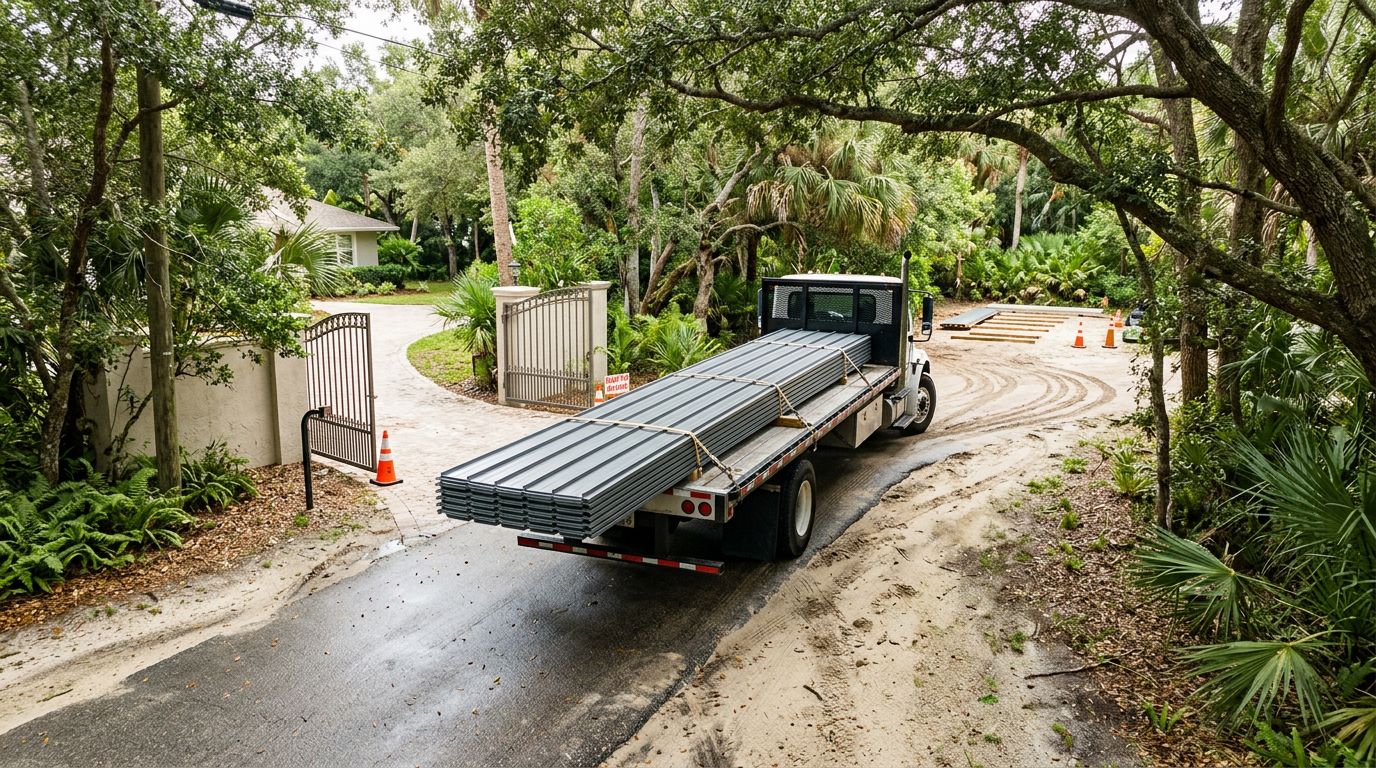
A long metal panel can turn an ordinary driveway into a delivery constraint. Metal roofing delivery goes smoothly when the truck route, unloading area, and panel storage location are planned before the order leaves the supplier.
For Florida contractors and property owners, access problems often hide behind gates, sandy shoulders, low branches, tight turns, and soft ground after rain. A few accurate measurements can prevent a missed delivery, damaged panels, or a truck that can't reach the drop point.
Start by treating panel length as a jobsite logistics decision, not only a roofing measurement.
Why Long Panels Change the Delivery Plan
Long panels reduce end laps and can create a cleaner roof layout. However, their length also affects how the delivery truck turns, where bundles can be placed, and what equipment can unload them safely.
A route that works for shingles, lumber, or short trim may not work for long roofing material. The truck needs room to swing through turns without clipping fences, trees, parked vehicles, roof overhangs, or utility lines.
Turning space matters beyond the gate
A wide gate doesn't solve a tight approach. The driver may need extra room on the road before turning into the entrance, especially when a trailer follows the truck through the turn.
Measure both sides of the entrance. Check mailboxes, culverts, ditches, decorative columns, fence corners, and parked equipment. If the truck must turn around on site, inspect that area with the same care.
A gate opening may fit a pickup and still block a trailer's turning path. Measure the approach before the gate, not only the gate itself.
If a turn looks questionable, send photos and measurements to the supplier before scheduling. A carrier can then advise whether the route needs a different unloading point or delivery arrangement.
Bundle details affect handling choices
Panel bundles vary by profile, gauge, width, length, and quantity. Don't guess their weight based only on the number of panels. Ask for the expected bundle dimensions, total weight, unloading method, and any handling instructions.
Long pieces of ridge cap, valley flashing, and custom trim also need a protected landing area. When ordering matching components, use a custom metal roof trim ordering guide to confirm profiles, lengths, orientation, and accessories before delivery day.
Measure Metal Roofing Delivery Access Before Scheduling
Good metal roofing delivery planning begins with a written access sheet. Walk the full route from the public road to the proposed unloading point. Measure the narrowest and lowest locations, not the open areas around them.
Use a tape measure, measuring wheel, laser measure, or site plan. Photos help, but a photo without dimensions leaves too much open to interpretation.
| Location to check | What to measure | Why it affects delivery |
|---|---|---|
| Public road and entrance | Road width, turn space, gate opening | The truck needs room to line up and turn |
| Driveway | Narrow points, curves, slope, surface condition | Long loads need stable travel space |
| Overhead area | Tree limbs, power lines, roof edges, signs | Clearance can limit the truck path |
| Unloading zone | Width, length, ground firmness | Bundles need a safe place to land |
| Turnaround area | Diameter and obstacles | The driver may need space to exit forward |
Record measurements in feet and inches, then label the photos. Include a photo looking toward the entrance from each direction on the road. Also show any sharp turn, steep grade, gate, bridge, or overhead obstruction.
Check ground conditions, not only dimensions
Florida driveways can change quickly after heavy rain. A sandy shoulder or grassy area may look firm when empty but fail under a loaded truck or forklift. Likewise, pavers, septic areas, drainage structures, and narrow culverts may have load limits.
Ask the property owner about buried irrigation, septic tanks, drain fields, propane lines, and shallow utilities near the intended drop zone. Keep delivery vehicles on a surface approved for their weight whenever possible.
If the route crosses private property or a shared drive, get permission before the truck arrives. A delivery delay is less expensive than repairing a damaged lawn, gate, or drainage feature.
Trace the Route Before the Truck Leaves the Yard
The final approach deserves more attention than the straight road leading to the property. A long panel load follows the trailer's path, which can be wider than the truck's path through a corner.
First, compare the access information with the carrier's equipment. Ask whether the load will arrive on a flatbed, trailer, boom truck, or another vehicle type. The truck's length, height, turning needs, and unloading capability affect the plan.
Look for low clearances and fixed obstacles
Tree limbs often cause the first problem on rural and residential sites. Trim only where permitted, and never cut around power lines yourself. Contact the utility or a qualified tree professional when clearance involves electrical conductors.
Check for:
- Low branches, hanging signs, roof edges, and overhead service lines along the full route.
- Tight intersections, medians, street parking, or construction barriers near the property entrance.
- Bridges, culverts, soft shoulders, and steep transitions where a long vehicle could bottom out.
- Locked gates, keypad entries, guard stations, or neighborhood rules that may delay access.
Site-specific traffic, lifting, permitting, and safety requirements should be verified with qualified professionals and local authorities before delivery day. Some communities also require advance notice for large vehicles or temporary traffic control.
Give drivers an exit plan
A truck should not enter a narrow property without a clear way out. Backing a long load through a curved drive increases risk and may not be practical.
When possible, plan a forward exit or a verified turnaround area. Move personal vehicles, trailers, dumpsters, material stacks, and equipment before the scheduled arrival window. Keep the access lane open until the truck has left the site.
Prepare the Unloading Area Before Delivery Day
The best drop zone is close enough to the roof that the crew won't handle every panel twice. At the same time, it needs enough room for the truck, unloading equipment, workers, and a protected stack of materials.
Choose level, firm ground away from drainage paths and standing water. Avoid placing bundles where vehicles must drive later, where falling debris could hit them, or where a crane or forklift cannot reach safely.
Set a clear landing zone for panel bundles
Mark the drop area with cones, stakes, or visible markers. If the driver can't see the intended spot from the approach, assign one competent ground guide who knows the plan.
Place dunnage or other suitable supports before arrival. Keep panels off bare soil, wet grass, and puddled pavement. Follow the supplier's guidance for support spacing, bundle orientation, and storage limits.
Leave room around the stack for unloading and inspection. Bundles should not block exits, scaffold access, or the path needed to move materials to the roof.
Keep people out of the unloading path
Long panels can flex, catch wind, and shift when workers move them by hand. Limit the unloading area to trained workers with assigned roles. Children, homeowners, pets, and visitors should stay away until the driver and crew finish.
Confirm who will direct the truck, who will inspect the load, and who has authority to stop work if conditions change. High winds, lightning, saturated ground, or an unexpected obstruction can require a new plan.
Share the Right Details With Your Supplier and Driver
A supplier can't plan around access information they don't have. Provide panel lengths, delivery address, contact numbers, gate instructions, and the best entry route when placing the order.
Also share photos of the narrowest driveway point, the unloading zone, and any issue that could affect a long load. Tell the supplier if the job has a gated community, a restricted delivery window, a school-zone concern, or a road that can't accommodate a larger truck.
When you request a metal roofing jobsite delivery, include the access notes with the order details rather than relying on a last-minute phone call.
Confirm the day-before communication plan
Set one primary contact who can answer the phone during the delivery window. That person should have authority to open gates, move vehicles, approve the drop location, and contact the customer if needed.
Confirm these points before dispatch:
- The panel lengths, bundle count, trim pieces, and accessory pallets match the order.
- The driver has the correct site address and a route that avoids known restrictions.
- Unloading equipment and trained personnel will be ready when the truck arrives.
- Rain, wind, road closures, or worksite changes have not affected access.
For a broader order review, the Florida metal roof material ordering guide can help verify panels, trim, fasteners, flashing, and other materials before delivery.
Unload Long Panels Without Creating New Damage
The delivery truck arriving on time is only part of the job. A rushed unload can bend panels, scratch finishes, damage edges, or put workers in a hazardous position.
Use equipment that is appropriate for the load and operated by qualified personnel. Forklift capacity changes with the load center, so long bundles need proper fork spacing and a confirmed lift plan. If a boom truck, crane, spreader bar, or lifting beam is involved, follow the equipment manufacturer's instructions and site safety requirements.
Follow a deliberate unloading sequence
A clear sequence reduces confusion when the truck is on site.
- Inspect the access route and drop zone again before the truck enters.
- Confirm the bundle labels, panel lengths, quantities, and visible condition.
- Clear nonessential people from the unloading area and establish ground-guide signals.
- Set bundles on prepared supports, then protect them from standing water and jobsite traffic.
- Count trim, fasteners, closures, sealants, and other loose materials before the driver departs.
Avoid dragging panels across concrete, gravel, or other panels. Lift individual pieces with enough people for their length and wind exposure. Keep protective film and packaging in place until the installation crew needs to remove them.
Common Delivery Access Failures and How to Avoid Them
Most long-load problems start with assumptions. Someone assumes the gate is wide enough, the driveway is firm enough, or the crew can unload without equipment. Those guesses can put the driver, workers, materials, and property at risk.
A driveway may be wide enough in a straight section but still fail at a 90-degree turn. A flat spot may look usable until a bundle lands across the only access lane. A homeowner may have measured the gate but missed a low limb on the public-road approach.
Prevent those issues by measuring the full route, checking conditions close to delivery, and giving the supplier complete information. If access remains uncertain, arrange a safer alternate drop point or consider pickup with suitable equipment.
Final Delivery Access Check
Long panels reward careful planning. The safest metal roofing delivery plan accounts for the truck's route, the ground under its wheels, the unloading equipment, and the final location of every bundle.
Measure before scheduling, share the details early, and inspect the site again on delivery day. A clear route and prepared drop zone protect the roofing materials before installation even begins.
Share Our Metal Roofing News Articles
Related Posts