How to Estimate Underlayment Rolls for a Metal Roof
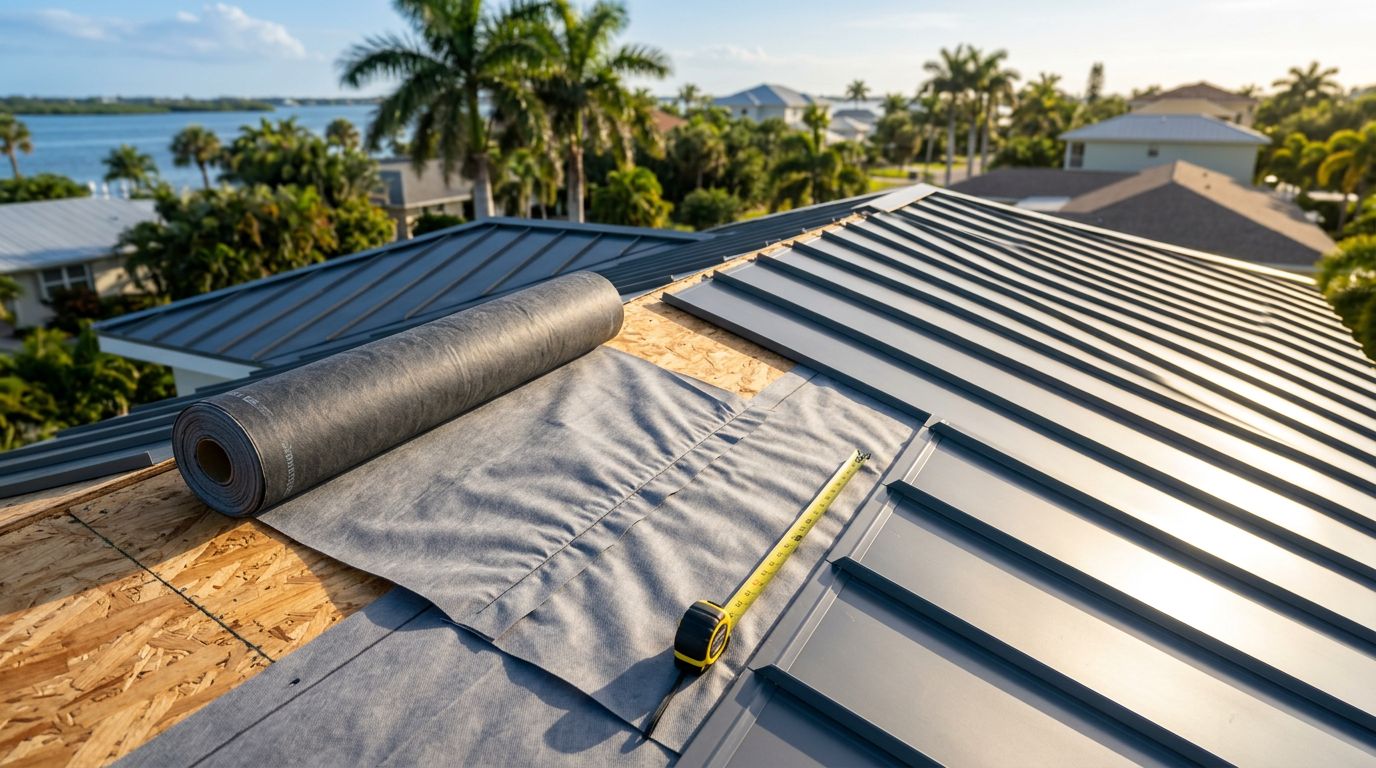
A roll marked 300 square feet doesn't give you 300 square feet of roof coverage. Once overlaps, cuts, valleys, and code details enter the picture, the usable amount drops fast.
That gap is where many roof orders go wrong. Order too little, and the crew stalls. Order too much, and the extra rolls sit in the way. If you're choosing a product for Florida heat and humidity, the roll count also depends on the underlayment type, because each system has its own lap and coverage rules. A quick look at underlayment options for humid Florida climates helps before you lock in the numbers.
The good news is that estimating underlayment rolls is simple once you separate gross coverage from usable coverage .
Why roll labels don't match real roof coverage
The label on a roll tells you the full surface area of the material. That is the gross number. Your roof order needs the net number, which is what remains after laps and cuts.
A few small details change the count more than most people expect.
| What changes the count | Why it matters |
|---|---|
| Side laps | Each seam overlaps the next sheet, so you lose width |
| End laps | Longer slopes often need a second row, which uses extra material |
| Valleys and hips | Trimming around angled areas creates waste |
| Penetrations | Vents, pipes, and skylights need cutouts and patch pieces |
| Code or product rules | Some products require wider laps or sealed seams |
Florida adds another layer. Roof assemblies have to follow the approved product instructions and the local code path for the job. If you are working on a reroof, check the Florida building codes for metal roofing before you order. That avoids a common mistake, buying a roll count that looks right on paper but fails the install rules.
The number printed on the wrapper is a starting point. The number you order should come from net coverage, not gross coverage.
A simple way to calculate metal roof underlayment rolls
The math works best when you follow the same order every time. Measure the roof first, then adjust for waste, then divide by the usable coverage per roll.
1. Measure the roof area
Break the roof into rectangles, triangles, or other simple shapes. Measure each plane separately, then add them together.
For a rectangle, use:
length x width = square footage
If a section is 30 feet by 20 feet, that plane is 600 square feet. Add every plane on the roof. Do not use the home's floor area. That misses overhangs and roof pitch.
2. Find the net coverage per roll
Next, check the product label or spec sheet. A roll might be sold as 300 square feet, but that is not always the usable number.
Why? Because the install may call for overlaps at the side seams or end laps. Some systems also use extra material at edges or transitions. The wider the required lap, the less roof you get from the roll.
Use the manufacturer's stated coverage when it gives you a net number. If it only lists roll dimensions, calculate the gross area first, then subtract the overlap allowance.
Net coverage per roll = gross roll area minus overlap and waste allowances
3. Add waste for the roof shape
Simple roofs need less extra material than cut-up roofs. A clean gable roof might only need a small cushion. A roof with valleys, dormers, and multiple pipes needs more.
A practical starting point is:
- 10% waste for a simple roof
- 15% waste for a moderate roof
- 20% or more for a complex roof
That is not a fixed rule. It is a planning range. The more cuts and details you have, the higher the waste goes.
Valleys deserve special attention because they can consume more underlayment than a flat field area. If your roof has them, review valley underlayment for Florida metal roofs while you estimate. It helps you account for the extra buildup at those spots.
4. Divide and round up
Use this formula:
Rolls needed = adjusted roof area ÷ net coverage per roll
Always round up. A partial roll is not enough.
Sample calculation for a Florida metal roof
Here's a straightforward example.
A roof has a total area of 2,400 square feet . The roof is simple, but it still has a few penetrations, so you add 10% waste .
2,400 x 1.10 = 2,640 square feet
Now assume the underlayment roll is sold as 300 square feet gross , but the required laps bring the usable coverage down to 270 square feet per roll .
2,640 ÷ 270 = 9.78
That means you need 10 rolls .
If the roof has more valleys or roof breaks and you move to 15% waste , the math changes.
2,400 x 1.15 = 2,760 square feet
2,760 ÷ 270 = 10.22
That still rounds up to 11 rolls .
The difference comes from the roof shape, not just the roll label. That is why the same house can need a different order when the plan changes.
Common estimating mistakes that waste money
Most under-orders start with one of a few simple errors. The good news is that they're easy to avoid.
- Using floor area instead of roof area . The roof is larger than the living space below it.
- Treating gross roll area as usable coverage . Laps and cuts reduce the real number.
- Skipping waste on cut-up roofs . Valleys, hips, and dead ends eat material fast.
- Forgetting detail areas . Eaves, walls, and penetrations all need attention.
- Ignoring product specs . Different metal roof underlayment products have different lap needs.
- Ordering to the exact roll count . That leaves no room for damaged material or small layout changes.
A vague line item can also hide problems. If a bid says only "underlayment" with no brand, type, or coverage, compare it with underlayment details in metal roof quotes before you approve it. Clear specs make the roll count easier to trust.
What to gather before you order
A good estimate gets easier when you have the right details in hand. Before you place the order, collect this information:
- Roof measurements for each plane
- Roof pitch, if it affects layout or waste
- Underlayment type and brand
- Roll dimensions and stated coverage
- Lap requirements from the product instructions
- Valley, hip, ridge, and penetration details
- Florida approval or code notes for the system
- Any extra material needed for repair patches or tie-ins
With that list, you can compare products more accurately and avoid a short delivery. It also helps when you're working from a supplier quote, because you can match the order to the written specs instead of guessing.
If you are still sorting through product choices, the underlayment type matters as much as the quantity. A synthetic sheet, a high-temp self-adhered membrane, and felt do not all cover the same way, and they do not all install the same way. That affects both the order size and the job schedule.
Conclusion
Estimating underlayment rolls comes down to one simple habit, count the roof by usable coverage, not by the number on the wrapper. Once you measure the roof, add waste for the layout, and subtract for laps, the math gets clear fast.
That approach keeps the order honest. It also saves time on install day, because the material on site matches the roof in front of you.
A solid metal roof underlayment estimate is not guesswork. It's careful measuring, the right product spec, and a little room for the real shape of the roof.
Share Our Metal Roofing News Articles
Related Posts