Florida Secondary Water Barrier Guide For Metal Roof Re-Roofs
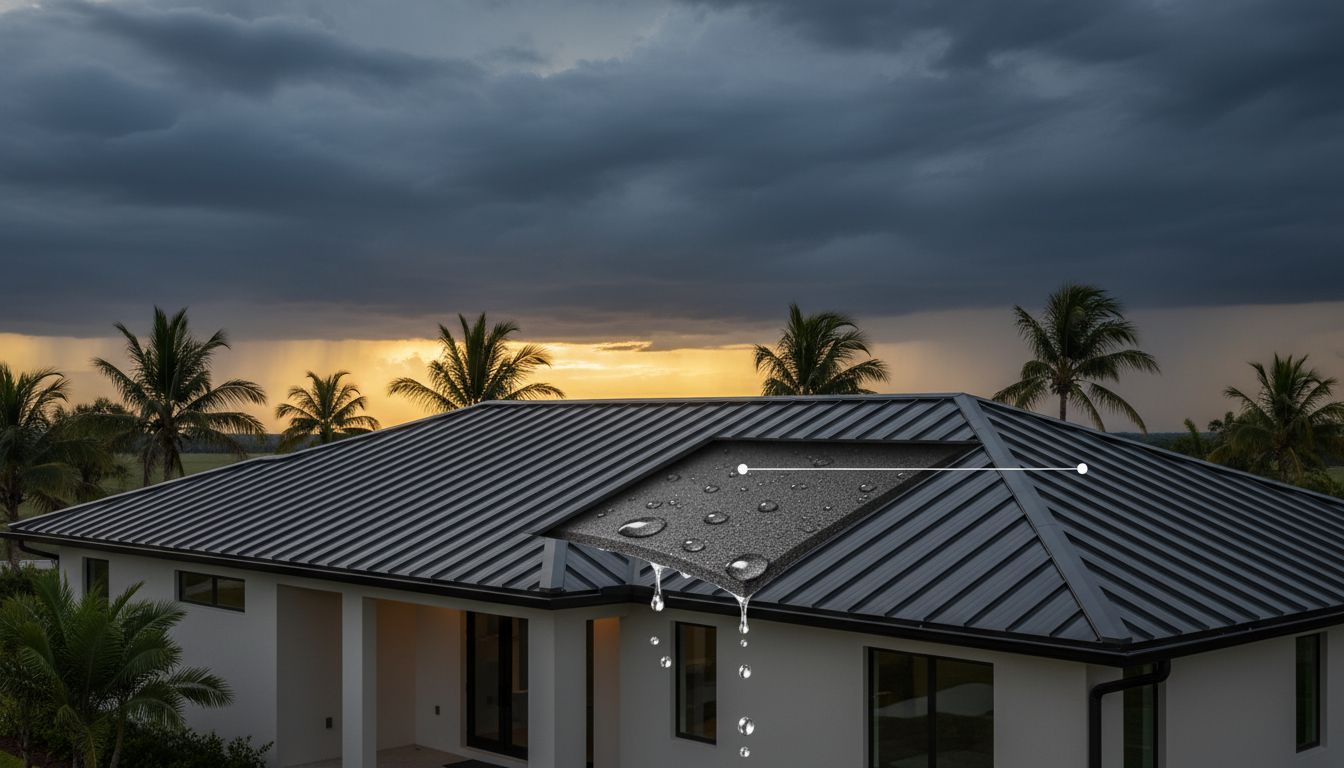
A metal roof is tough, but Florida storms don't play fair. Wind-driven rain can get under panels, and if a panel section ever lifts in a hurricane, water can pour straight onto the deck.
That's why the florida secondary water barrier matters on a re-roof. Think of it like a rain jacket under your outer layer. You hope you never need it, but when you do, it can save the house.
This guide breaks down when Florida expects an SWB, what options work under metal, and what to document for permits and insurance. Local building departments (the AHJ) can enforce details differently, so always confirm your exact requirements before work starts.
What Florida means by "secondary water barrier" on a re-roof
A secondary water barrier (SWB) is a waterproof layer on top of the roof deck, under your metal roofing system. It's there for the ugly scenario: wind gets past the primary roof covering, or a section of roof covering is damaged, and rain still has a path into the attic.
In Florida, SWB requirements show up in the Florida Building Code during roof replacement work, not just new builds. Code language is updated on a cycle, and as of February 2026 many areas are enforcing the 8th Edition (2023) FBC. For residential re-roofs, you will often see SWB called out under provisions such as FBC Residential R908.7.2 (secondary water barrier for existing structures with wood roof decks), with related references to underlayment and roofing sections.
Older, pre-FBC homes (built before March 1, 2002) are a common trigger point in the field, because Florida also tied roof retrofit rules to state law (for example, Florida Statutes 553.844 , created out of hurricane mitigation legislation). Your local permit office will tell you how they apply it to your project.
A big "gotcha" with metal re-roofs is whether the deck is exposed. If you tear off to plywood or OSB, inspectors can easily verify SWB. If you're doing a roof-over, the rules can be different because the deck may not be accessible. Before you assume anything, review the roof-over approach and its limits in metal roofing over shingles in Florida, then confirm it with your AHJ.
For a broader, Florida-focused view of code compliance on metal roof projects, it also helps to skim Florida building codes for metal roofing so you know what inspectors tend to ask for.
An SWB isn't there to stop normal rain. It's there to buy you time when wind and water get violent.
SWB options for metal roof re-roofs (what actually passes inspection)
Homeowners often hear "just put down underlayment." Underlayment is required, but not every underlayment qualifies as an SWB. An SWB needs to be waterproof as a system, including seams and laps, not only "water-resistant."
Under metal panels, the most common SWB approaches fall into three buckets:
| SWB approach | Where it fits best | What to watch for |
|---|---|---|
| Full self-adhered membrane over the deck | High-wind areas, complex roofs, many penetrations | Needs clean, dry deck, careful rolling at laps and corners |
| Sealed deck seams plus code-approved underlayment | Simpler roof geometry, budget-sensitive jobs | Tape compatibility, fastener sealing, clean transitions at edges and valleys |
| Hybrid (membrane in vulnerable zones, underlayment elsewhere) | Many re-roofs where you want extra protection without full coverage | AHJ acceptance varies, detail work must be consistent |
Full self-adhered membranes (often called peel-and-stick) are the straightforward path because they naturally create a sealed surface. They're also popular under standing seam and other metal systems because they help control water that sneaks past flashing during wind events.
Sealed seam methods focus on making the deck itself act "sealed" by treating joints and then installing an approved underlayment above. This can work, but only if the materials are compatible and the crew treats every seam like a flashing detail.
Hybrid methods can be practical when you want maximum protection at eaves, valleys, rakes, transitions, and around penetrations. Still, don't treat "hybrid" as a shortcut. Inspectors often look hardest at the exact places hybrid systems change materials.
No matter which approach you choose, ask for products with the right approvals for Florida. Many AHJs want to see Florida Product Approval numbers, and in the High-Velocity Hurricane Zone (HVHZ) you may also run into Miami-Dade NOA requirements.
If you want a Florida-climate breakdown of underlayment types used under metal, start with best underlayment for metal roofs in Central Florida and then match it to your code path for SWB.
Metal roof SWB details that fail in the real world (and how to avoid them)
Most SWB problems don't come from the big flat field. They happen at interruptions, where water can turn sideways.
Start with the basics. The deck must be sound, dry, and well-fastened. Florida re-roofs often include a deck attachment upgrade (re-nailing or similar) when required by code or by the inspector's office. A great membrane can't save rotten decking.
Next, focus on continuity. Your SWB has to connect across edges, valleys, and penetrations without weak links. In practice, that means:
- Eaves and rakes : Terminate cleanly and tie into edge metal details. Wrinkles at the edge become wind grabs.
- Valleys : Treat them like a gutter. Keep laps shingled correctly, and avoid "fishmouth" folds.
- Pipe boots and vents : Use the SWB to create a clean, sealed flange area before the metal flashing goes on.
- Fastener strategy : Even with an SWB, you still want fewer unnecessary holes. Follow the metal system's fastening pattern and keep penetrations intentional.
Also, don't confuse condensation with leaks after the job. Florida humidity can create sweating under metal, especially when attic air sealing or ventilation is off. If you want a quick way to tell the difference, review metal roof condensation in Florida, causes and fixes.
One final field note: SWB should not become an excuse to get sloppy with flashings. A secondary barrier is backup, not the main plan.
Permits, inspections, and SWB paperwork to keep (for the AHJ and insurance)
A re-roof in Florida almost always needs a permit, and SWB is often checked at the dry-in stage. Since metal panels hide the layers below, photos and documentation matter more than most homeowners expect.
Ask your roofer for these items and save them in one folder:
- Permit info and inspection sign-offs (permit number, job address, finals)
- Product approval documentation for underlayment and any SWB membrane system (Florida Product Approval, and HVHZ approvals if required)
- A simple SWB scope statement on the contract or proposal (what method, where installed)
- Progress photos of the bare deck (if exposed), SWB installation, laps at valleys and penetrations, then underlayment and flashings before panels
- Final paid invoice with the system description, because insurers often ask for it later
If you're pursuing wind mitigation credits, ask your inspector what documentation they need for the wind mitigation form used in Florida (many homeowners know it as the OIR wind mitigation form). The goal is simple: prove what's installed, even years from now.
A clean paper trail makes the permit process smoother, and it can also help when you sell the home or file a claim.
Conclusion
A florida secondary water barrier is your quiet safety net under a metal re-roof. When it's detailed right, it helps keep a bad storm from turning into a soaked attic and ruined ceilings. Focus on an approved SWB method, clean transitions at edges and penetrations, and solid documentation for the inspector and your insurer. If your roofer can explain the SWB plan in plain language, you're already ahead.
Share Our Metal Roofing News Articles
Related Posts