Wind Uplift Ratings Explained, Picking Metal Roof Panels for Central Florida Wind Zones
In Central Florida, wind doesn’t just push sideways. It pulls up, like a giant trying to peel the lid off your house. That upward pull is why metal roof uplift ratings matter, and why a simple claim like “rated for 160 mph” doesn’t tell you enough.
If you’re a homeowner comparing panels, or a contractor ordering material for a permit, here’s the key idea to keep in mind: uplift ratings are tied to a tested roof assembly , not just a panel shape. Panel, clip, fasteners, spacing, substrate, and even edge details work together, and the corners almost always demand the toughest setup.
Wind uplift ratings in Florida are about the whole assembly, not the panel alone
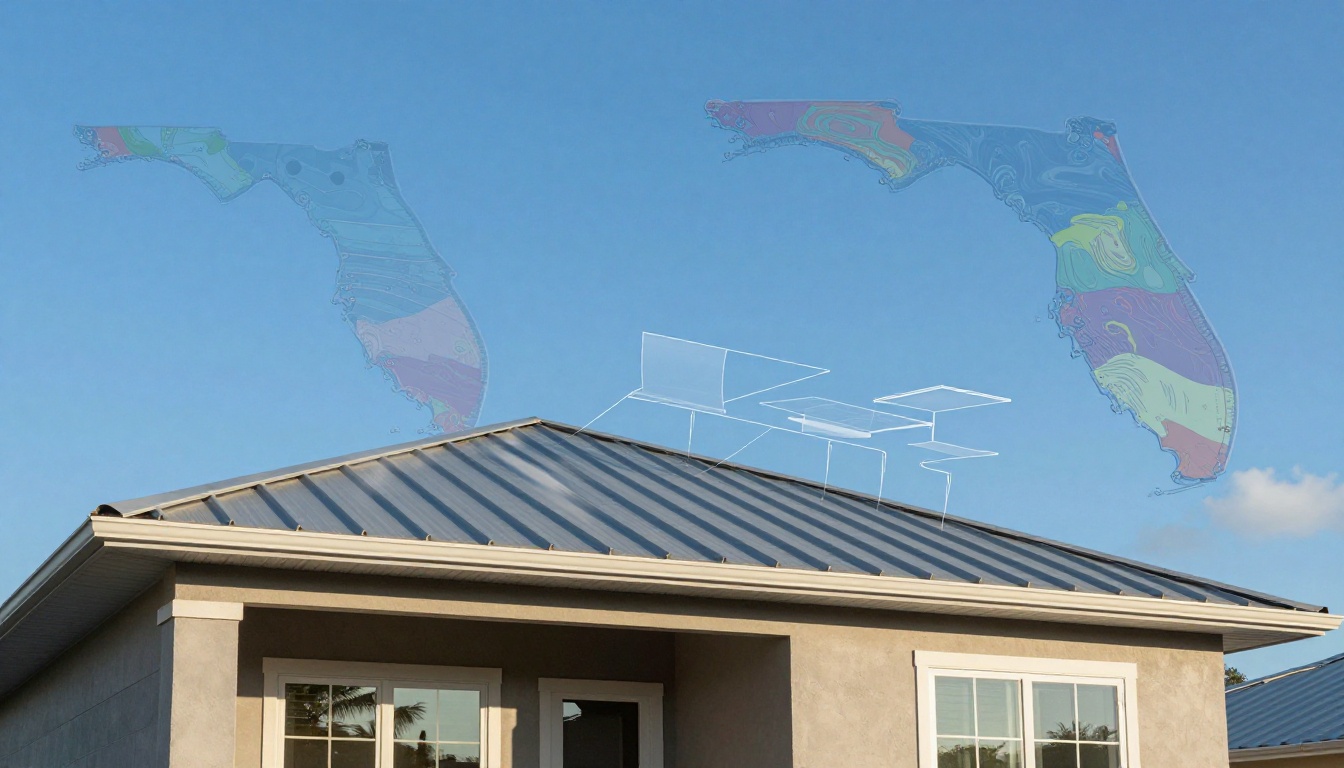
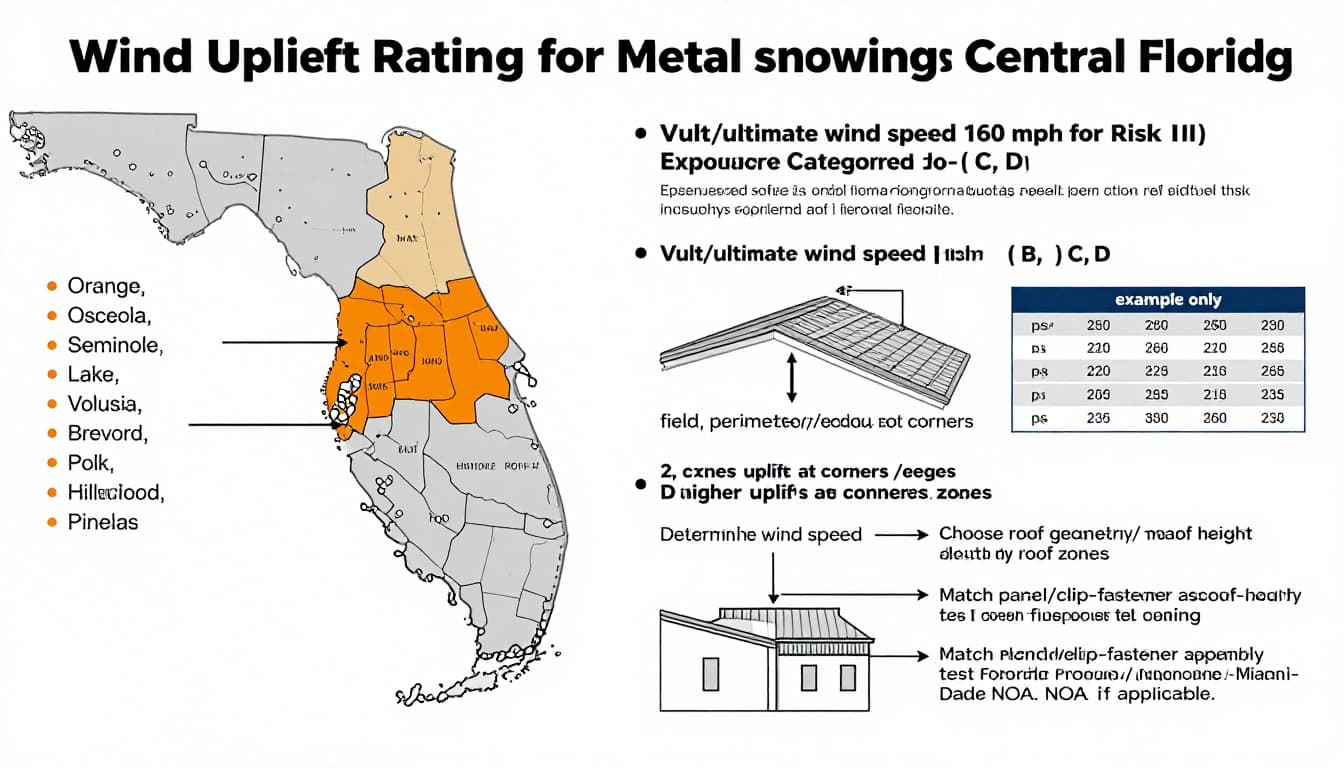 Infographic showing how wind speed, exposure, and roof zones connect to uplift pressures and tested metal roof assemblies, created with AI.
Most confusion comes from mixing up wind speed with wind pressure. Codes and approvals don’t approve “mph roofs.” They verify that a specific roof system resists a required design pressure , usually shown in pounds per square foot (psf). Think of psf like suction on a big sheet of metal. The wider the sheet and the higher the wind load, the more it wants to lift.
That’s why metal roof uplift ratings are always tied to details like:
- Panel profile and metal thickness (gauge)
- Clip type (for standing seam), screw type (for exposed fastener), and washer style
- Clip spacing and screw spacing (often different in corners)
- Substrate (plywood/OSB thickness, purlins, steel deck)
- Underlayment or “sealed roof deck” requirements when applicable
- Edge and corner detailing (where failures usually start)
As of February 2026, Florida is operating under the Florida Building Code, 8th Edition (2023), and its wind provisions correlate with ASCE 7-22 . The Florida Building Commission summarizes those updates in its ASCE 7-22 wind loads fact sheet, including changes to wind maps and pressure rules.
A practical takeaway: when someone asks, “Is this panel hurricane-rated?”, the better question is, “What’s the tested uplift pressure for this exact assembly, in the roof zones on this house?”
Central Florida wind zones: Vult, exposure, and why corners change everything
Florida wind design starts with your location and building type (most homes are Risk Category II). In many inland Central Florida areas, ultimate wind speeds around 160 mph are common, but the correct value still depends on the exact site. The maps were updated for the 8th Edition, backed by research like the University of Florida GeoPlan work on wind speed lines, documented in the FBC wind speed map update report.
Then come the “settings” that swing uplift up or down:
Exposure category (B, C, or D).
Exposure B is more sheltered (neighborhoods with trees and houses). Exposure C is more open (fields, large lakes nearby). Exposure D is open water exposure. More open exposure usually means higher pressures.
Mean roof height and roof shape.
Taller roofs see higher wind pressures. Roof pitch and geometry also affect suction, especially on steeper slopes.
Roof zones (field, edge, corner).
ASCE-based methods divide the roof into zones. The field is the “middle,” edges are the perimeter strips, and corners are the small squares at each corner. Corners take the worst suction, like wind grabbing the end of a tarp.
Here’s a simple, generic illustration of how pressures ramp up by zone (example only, not a design):
| Roof area (zone) | Example net uplift pressure (psf) | What it usually means in practice |
|---|---|---|
| Field | -40 psf | Standard clip/screw spacing might work |
| Edge (perimeter) | -60 psf | Often needs tighter spacing or added fasteners |
| Corner | -90 psf | Tightest spacing, strongest attachment details |
That ramp is why “one spacing for the whole roof” can be a costly mistake. Many approved systems allow multiple spacings, but only if you follow the zone layout.
If you’re near large open water or right on the coast, wind-borne debris rules can also come into play. ASCE 7-22 refined how debris regions are defined, discussed in the Florida Building Commission’s wind-borne debris regions interim report. That topic is separate from uplift, but it often shows up in the same permit conversation.
Picking metal roof panels for Central Florida, with a corner-zone walkthrough and permit tips
Panel choice matters, but it’s only step one. Exposed-fastener panels (like PBR and 5V) and standing seam systems can both be code-compliant in Central Florida, as long as the approved assembly matches the pressures for each zone.
If you’re comparing profiles, it helps to understand what you’re buying beyond looks:
- Exposed-fastener panels : Faster to install, more economical, but long-term performance depends heavily on correct screw type, washer quality, and spacing. Panel ribs add stiffness, but screws do the holding.
- Standing seam : Concealed clips and seams can improve water management and reduce exposed penetrations, but clip type and clip spacing become the make-or-break details for uplift.
If you’re ordering materials, a good habit is to treat the job like a system, not a stack of parts. This Central Florida metal roofing materials checklist is a solid reminder of all the pieces that affect performance, including fasteners and flashings that often get value-engineered a little too hard.
Walkthrough example (hypothetical): how a corner zone can force tighter clip or screw spacing
Picture a one-story home in Polk County with a 5:12 roof, mean roof height around 20 feet, Exposure B (suburban neighborhood). Assume the site wind speed and inputs produce these example-only net uplift pressures:
- Field: -45 psf
- Edge: -70 psf
- Corner: -100 psf
Now the key move: you don’t pick a panel and hope. You match those pressures to a tested assembly.
A standing seam approval might show something like:
- 12 inch clip spacing passes up to -60 psf
- 6 inch clip spacing passes up to -105 psf
On this example house, 12 inch spacing could be fine in the field, might fail at the edge, and almost certainly fails at the corners. That pushes you toward a zone-based layout, such as 12 inch clips in the field, tighter spacing at edges, and 6 inch clips in corner zones, but only if the specific approval and installation instructions allow it.
The same idea applies to exposed-fastener panels. The corner zone might require closer screw spacing, a different fastener, or a thicker substrate than the field. That’s also why a “pretty close” screw pattern can turn into a failed inspection when the plans call for corner-zone reinforcement.
For homeowners who like the traditional Florida look of 5V, make sure you’re working from the current technical documents for the system you’re installing. Product-specific resources (like data cards and manuals) are often linked directly on the product page, such as these 5V metal roof panel specs and manuals.
Permit documentation and red flags that trip up approvals
Most jurisdictions want proof that your roof covering meets the required design pressures. Common documentation includes the product approval number, the evaluation report, and the exact installation instructions used on site. For Florida, a helpful starting point is the Florida Building Commission’s product approval guidance pages, including policy notes like its product approval rule reference.
In HVHZ areas (not Central Florida, but relevant if you work statewide), you may also hear “Miami-Dade NOA” mentioned. A plain-language explanation is covered in Florida Product Approval vs Miami-Dade NOA. For an example of what an NOA looks like in the real world, Miami-Dade posts the full documents, such as this sample Miami-Dade NOA PDF.
Red flags to avoid on wind jobs are pretty consistent:
- Mixing panels, clips, or fasteners that were not tested together
- Using “standard spacing” everywhere and ignoring edge and corner zones
- Substituting a thinner deck, different purlins, or different screw length than the approval requires
- Installing from memory instead of the current manual and approval tables
For final design pressures, zone layouts, and fastening schedules, it’s smart to work with a licensed Florida roofing contractor and, when required by the permit scope, a Florida-licensed engineer. That’s the cleanest way to line up the assembly rating with the real pressures on your roof.
Conclusion
Metal roofs do great in Florida wind, but only when the metal roof uplift ratings you’re relying on match the real roof zones and the exact assembly being installed. Treat corners and edges like the stress points they are, verify pressures in psf, and keep your product approvals and installation instructions aligned with the permit set. When in doubt, get a licensed pro to confirm the schedule before panels go on, because the best time to fix uplift details is still on paper.
Share Our Metal Roofing News Articles
Related Posts