Metal Roof Panel Cut Length Limits For Florida Transport And Handling
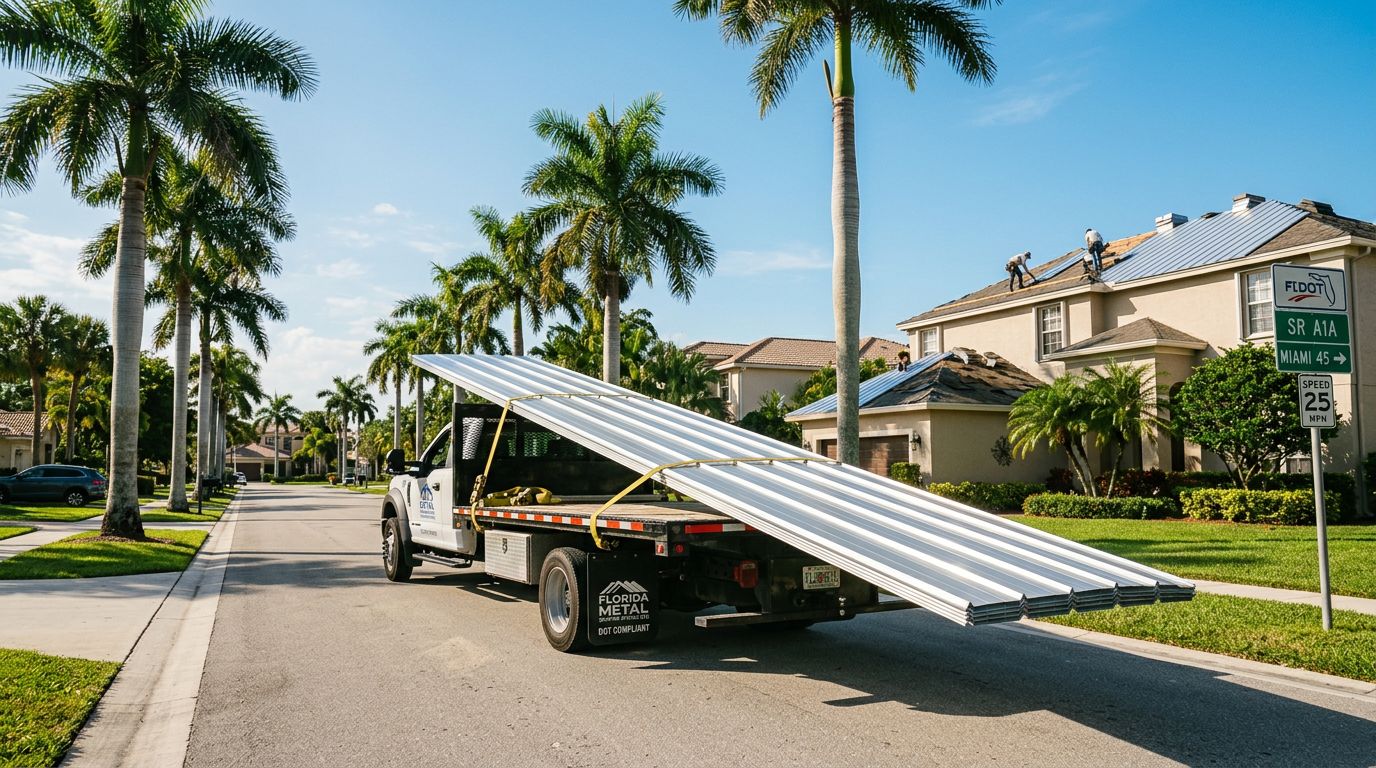
Ordering the right metal roof panel length feels simple until you picture a 30-foot panel in a tight subdivision street, a windy driveway, or a jobsite with no forklift. In Florida, length isn't just a convenience issue, it affects trucking rules, permit needs, damage risk, and how fast a crew can install.
This guide breaks down the real limits that matter in March 2026, from legal road limits to practical manufacturing and jobsite handling. You'll also get a quick rule-of-thumb "calculator" and a pre-delivery checklist you can hand to your crew.
Florida road rules that can cap panel length (legal limits)
Florida sets vehicle and combination length limits in state law (commonly cited under Florida Statutes Chapter 316.515) and enforces oversize travel through FDOT permitting. Metal roofing panels usually count as a non-divisible load (you can't "shrink" them without changing the product), so permitting can apply when you exceed standard limits.
Here's the simple way to think about it: your panels can be any cut length, but the truck hauling them cannot exceed legal dimensions without a permit .
To make the differences easy to spot, use this comparison.
| Limit type | What it controls | Florida-relevant baseline (typical) | What it means for panels |
|---|---|---|---|
| Straight truck length | Truck only, no trailer | About 40 ft max | Long panels can force a trailer, or a permit |
| Truck and trailer combo | Total combo length | About 68 ft (common cap) | Route planning matters, especially off highways |
| Semitrailer length | Trailer deck length | Commonly 48 ft , sometimes 53 ft | Keeping panels under trailer length avoids overhang issues |
| Oversize permit trigger | Legal max exceeded | Over legal limits for length | Permit can add cost, timing, and travel restrictions |
Even when interstates feel "limit-free," access roads and local routes still matter. Also, Florida can restrict oversize movements on holidays or peak travel windows, which can push your delivery date.
If you're close to a limit, ask the carrier what trailer type they're dispatching (48 ft, 53 ft, or specialty) before you lock in panel length.
Quick disclaimer: Regulations and permit requirements can change. Confirm current requirements with FDOT permitting, your carrier, or a permit service for your route and date. This is general planning info, not legal advice.
Practical cut length limits (manufacturing vs shipping vs jobsite reality)
Legal limits are only one part of the story. The more common problem is practical handling. A long panel acts like a sail, and Florida afternoon gusts don't care how experienced your crew is.
Manufacturing limits: what can be roll-formed and cut cleanly
Many Florida manufacturers can produce long panels, but they still work within equipment, runout space, and quality control. For example, Mid Florida Metal Roofing Supply discusses custom lengths (including longer lengths for specialized needs) and also points out why correct cutting methods protect coated edges, which matters if you decide to shorten panels in the field later.
If your layout might require trimming, plan ahead and use proper methods to cut metal roofing panels on site so you don't burn the coating or create rust-prone edges. This guide helps: best tools for field cutting metal panels.
Shipping limits: what moves without drama
From a shipping standpoint, the "easy button" is keeping panels within common trailer lengths and avoiding permit triggers. In real-world scheduling, fewer permits usually means:
- Faster dispatch and fewer route constraints
- More carriers willing to haul the load
- Less chance a delivery gets bumped by a restricted travel day
Handling limits: what your crew can safely control
On the ground, long panels bend easier and get kinked at corners, especially thinner gauges and taller ribs. Besides that, a 25-foot panel needs more clear space than most people expect. It's like carrying a full sheet of drywall, except it's longer, sharper, and catches wind.
As a planning range for many residential jobs:
- Under 20 ft often works with two experienced installers (conditions matter).
- 20 to 30 ft is where damage risk rises fast without equipment and a staging plan.
- Over 30 ft usually calls for mechanical handling (forklift, lull, boom) and more hands.
Separating "legal" length from "smart" length for Florida projects
The smartest panel length is often the longest piece you can install without splices, but only if you can transport and handle it safely. That tradeoff is different for each roof.
Here are common Florida situations that push you toward shorter cut lengths:
- Tight access neighborhoods : cul-de-sacs, street parking, low trees, and HOA rules can limit trailer access.
- High-wind days : long panels twist and scrape, especially near roof edges.
- Complex roof shapes : hips and valleys can create waste if you order long and cut a lot.
Before you pick a final metal roof panel length, it helps to validate your takeoff and waste assumptions. If you're still in the ordering phase, this walkthrough is useful: how to measure roof for metal panels in Central Florida. Once measurements are tight, ordering becomes less guesswork and more math: step-by-step guide to ordering metal roof materials.
Rule-of-thumb "calculator" to choose a workable panel length
Use this as a quick planning tool before you commit to extra-long panels. You're not trying to find one perfect number, you're trying to avoid the "we can't unload this" surprise.
Inputs to gather (5 minutes of prep)
- Panel profile (exposed-fastener like AG/PBR/5V, or standing seam)
- Gauge and finish (thinner panels flex more)
- Proposed panel length (in feet)
- Bundle weight (from your supplier's paperwork, don't guess)
- Equipment on site (forklift, lull, crane, spreader bar, roof staging plan)
Simple scoring rules (green, yellow, red)
- Transport check : If the panel length is close to trailer length, confirm trailer type and overhang rules with the carrier. If it pushes legal length, expect FDOT permit coordination.
- Handling check : If your longest panel is more than your crew can carry flat and steady, treat it as an equipment job.
- Profile check : Standing seam and high ribs show dents and kinks more easily, so treat "yellow" lengths as "red" if access is tight.
- Bundle check : If your unloading equipment can't safely lift the heaviest bundle, split bundles, reduce count per bundle, or shorten lengths.
A good target is the longest panel that can be unloaded, staged, and installed without dragging, flexing, or fighting wind.
Pre-delivery checklist for Florida contractors (print-friendly)
Use this the day before delivery and again when the truck is en route.
- Confirm trailer and route : Ask if it's a 48 ft or 53 ft trailer, and verify jobsite access.
- Verify permits (if needed) : If lengths trigger oversize rules, confirm who is pulling permits and what travel windows apply.
- Stage unloading space : Clear a straight, level area longer than your longest panel.
- Plan wind control : Schedule unloading early if possible, and assign enough hands for long pieces.
- Match equipment to bundles : Confirm forklift or lull capacity versus the heaviest bundle weight on the bill of lading.
- Prepare supports : Set dunnage and blocking so panels stay off the ground and supported.
- Protect finishes : Keep panels strapped until staging is ready, and avoid sliding panel on panel.
- Inspect on arrival : Count bundles, check lengths and colors, and note any damage before signing.
- Decide cut plan : If field cuts are expected, have the right shears or nibblers ready, and avoid abrasive tools.
Conclusion
Florida jobs run smoother when you choose a metal roof panel length that fits both the road rules and the jobsite reality. Legal limits can trigger permits, but handling limits are what usually break a schedule. Pick lengths that your carrier can deliver, your equipment can unload, and your crew can control in wind, then lock in your order with a clear staging plan. What's your biggest constraint on most jobs, transport access or jobsite handling?
Share Our Metal Roofing News Articles
Related Posts