Florida Roof Deck Attachment Rules For Metal Roof Re-Roofs
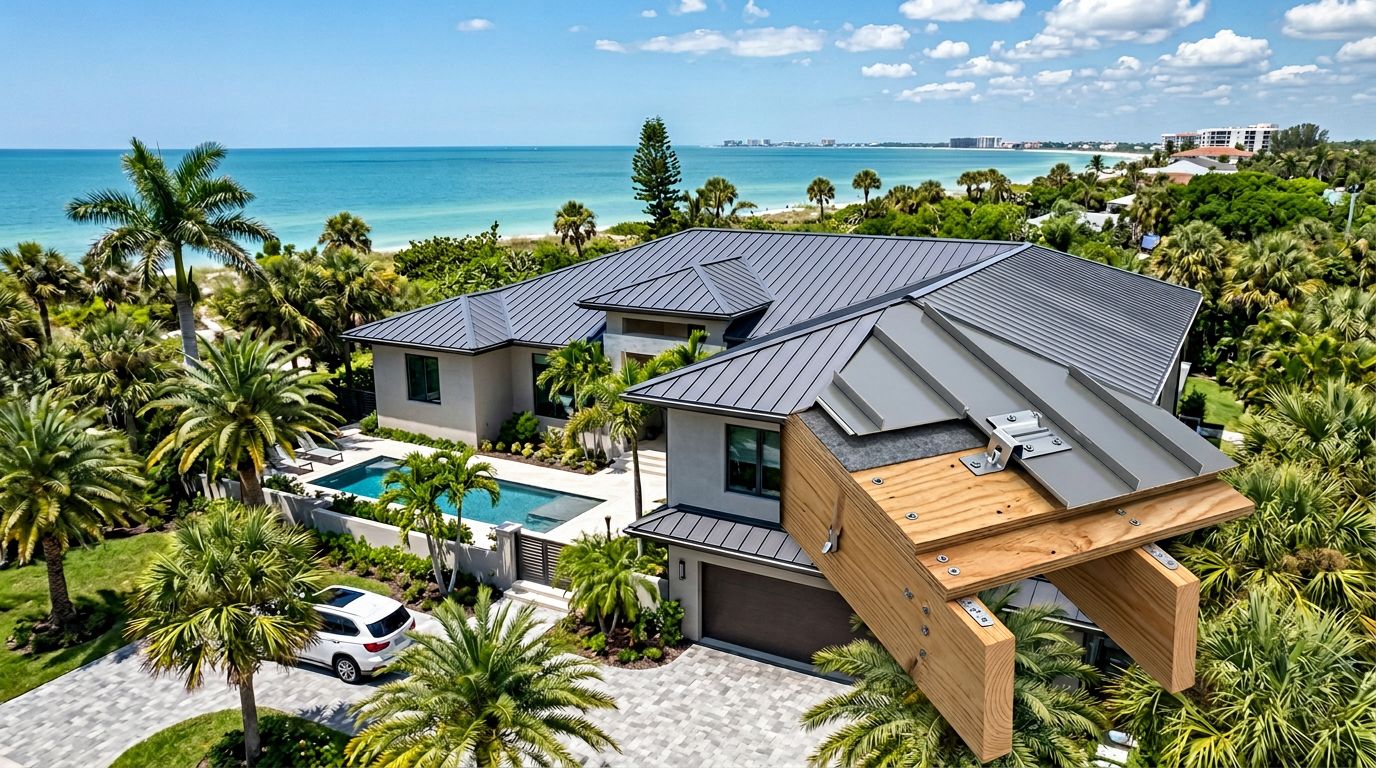
If you're putting a new metal roof on a Florida home, the panels aren't the first thing the inspector worries about. The big question is simple: will the roof deck stay attached when the wind tries to peel it off?
That's what Florida roof deck attachment rules are about. In most re-roof permits, the deck gets treated like the foundation of the whole roofing system. If it's weak, everything above it is at risk, including underlayment, clips, screws, and panels.
As of March 2026, most jurisdictions are enforcing the Florida Building Code (commonly the 2023, Eighth Edition, plus local amendments). Your city or county (the AHJ) controls the final call, so confirm the edition and any local changes before you order materials or schedule labor.
Why deck attachment matters more on metal roof re-roofs
A metal roof can handle serious weather, but only if the structure below it is solid. Think of the deck like the lid on a cooler. A strong lid keeps everything sealed, while a loose lid lets air and water push in fast.
In high wind, uplift forces try to pull roof coverings upward. Metal roofing systems often perform great in uplift testing, but uplift resistance still depends on the load path. That load path starts at the roof covering, goes through underlayment, then the roof deck attachment , then into trusses or rafters, and finally down to the walls.
That's why re-roof inspections in Florida often include deck checks, especially when the old roof comes off. Many older homes were built with staples, smooth shank nails, or wide nail spacing. Those can fail current requirements even if the wood "looks fine."
Metal re-roofs also tend to reveal problems you couldn't see before, such as:
- swollen OSB edges from old leaks
- delaminated plywood
- missed framing members (overdriven nails that never bit wood)
- soft decking around valleys, chimneys, and roof-to-wall transitions
If you're still deciding which profile fits your job, it helps to understand how different systems fasten and handle wind. See comparing metal roof panel types for Central Florida homes for a practical breakdown.
Florida roof deck attachment rules that commonly apply statewide
Most Florida roof deck attachment requirements for re-roofing come from these buckets:
- FBC Existing Building, Chapter 7 (roofing) , including re-roof triggers such as the "25 percent rule" (often cited as Section 706.1.1 in many jurisdictions).
- FBC Residential (Chapter 8 and roof framing) , including roof sheathing fastening tables (commonly referenced as Table R803.2.3.1).
- Wind design rules in FBC (Chapter 16), with roof uplift provisions tied to ASCE 7 (commonly ASCE 7-16 in current enforcement).
- Roof covering rules in FBC Residential Section R905 and FBC Building Chapter 15 (for metal roof coverings and system installation requirements).
While the exact schedule depends on wind speed, exposure, and deck type, inspectors frequently expect these concepts on metal re-roofs:
Ring-shank nails are the norm. Many re-roofs require upgrading deck fasteners to ring-shank nails because they resist pull-out better than smooth shank nails. Common references include ASTM F1667 ring-shank designations such as RSRS-03 (2 1/2 inch by 0.131 inch) and RSRS-04 (3 inch by 0.120 inch). The right length depends on deck thickness and framing.
Tighter nailing at edges. Florida wind zones hit roof perimeters harder, so the fastening pattern is typically denser at eaves and rakes than in the field. The accepted spacing comes from the code table your AHJ uses for your wind speed and exposure category.
Deck must be "nailable." Rotten, wet, or delaminated decking usually fails inspection. In that case, replacement is required, not "cover and go."
Re-roof scope can trigger upgrades. If your project meets the local interpretation of the 25 percent rule within a 12-month period, you may have to bring the full roof assembly up to current code, not just the area you replaced.
When your permit triggers a deck re-nail, it's not a penalty. It's the code forcing the roof system to act like one piece in hurricane wind.
Deck upgrades can change your budget and schedule, especially if you planned a fast tear-off and dry-in. For pricing factors that often surprise homeowners, read metal roof costs in Central Florida.
Extra requirements in HVHZ (Miami-Dade and Broward)
If the job is in the High-Velocity Hurricane Zone (HVHZ), expect stricter rules and closer inspection. Miami-Dade and Broward typically enforce additional standards within the Florida Building Code HVHZ provisions, plus recognized protocols used in permitting.
Three HVHZ items come up again and again on metal re-roofs:
1) HVHZ deck fastening patterns and edge zones. Fastener spacing is often more aggressive near perimeters and corners. Inspectors may reference Miami-Dade roofing application standards such as RAS 117 and RAS 137 for fastening and edge requirements.
2) Metal roof system approvals and uplift testing. In HVHZ, roof systems commonly need Miami-Dade product approvals, often documented by a Miami-Dade Notice of Acceptance (NOA) , and testing protocols such as TAS 125 (uplift). The approval is for the assembly, not just the panel profile.
3) Underlayment and sealed deck expectations. HVHZ typically requires more robust secondary water protection. In many cases, this means self-adhered underlayment and sealed laps, with installation details verified against the product approval and FBC HVHZ requirements.
Because HVHZ jobs can hinge on the exact approved assembly, your supplier, contractor, and permit set should match. Standing seam systems are popular in these areas because concealed fastening and tested assemblies can simplify compliance. If you're budgeting for that route, check standing seam metal panel costs in Central Florida.
Field guide for re-roof inspections (plus a deck attachment checklist)
Before you start, plan for the reality that many Florida re-roofs become "open-deck projects" for at least part of the day. That's when deck attachment gets judged.
Here's a quick table showing common triggers that lead to a deck re-nail or deck replacement during a metal re-roof:
| What's found during tear-off | Why it matters | Typical fix |
|---|---|---|
| Staples or smooth shank nails | Lower withdrawal strength in uplift | Re-nail to current schedule with ring-shank nails |
| Wide or inconsistent nail spacing | Deck can flutter and lift at edges | Add fasteners to meet the code table for your wind zone |
| Soft, swollen, or delaminated decking | Fasteners won't hold, deck may fail | Replace affected sheets, then re-fastener pattern |
| Missed trusses/rafters | Nails have no bite, attachment is fake | Correct fastening into framing, verify spacing |
The takeaway is simple: don't assume the old deck fastening will pass just because the roof "made it through" past storms.
Compliance checklist (use this before ordering panels)
- Confirm your AHJ's adopted FBC edition and any local amendments (city or county building department).
- Verify whether the permit scope triggers the re-roof upgrade threshold (often enforced using FBC Existing Building Chapter 7, including the 25 percent rule).
- Identify deck type and thickness (OSB vs plywood, thickness drives fastener length).
- Plan for ring-shank nails and the correct code-referenced fastening schedule (commonly tied to Table R803.2.3.1 and re-roof provisions such as Section 706.7.1).
- Check perimeter and corner zones, those areas often require tighter spacing.
- Replace damaged decking, don't "bridge" over soft areas.
- Confirm metal roof system approval requirements (Florida Product Approval statewide, and Miami-Dade NOA in HVHZ).
- Match underlayment and secondary water barrier details to the approved assembly (especially in HVHZ).
- Keep documentation on site (product approvals, fastening schedule notes, permit set).
- For edge cases (unusual framing, vaulted assemblies, engineered decks), confirm with the engineer of record or the building official.
This is practical construction guidance, not legal or engineering advice. When the job sits in a gray area, the safest move is to get written direction from the AHJ or your design professional.
Bottom line
Florida roof deck attachment rules can feel picky, but they're aimed at one thing: keeping the deck, and everything above it, attached in hurricane wind. If you plan for re-nailing, verify product approvals, and treat edges as a high-risk zone, your metal re-roof will go smoother.
If you're lining up a 2026 re-roof, ask early whether your project triggers upgrades to current code. That one detail often decides your timeline, your material list, and the strength of your finished roof.
Share Our Metal Roofing News Articles
Related Posts