Metal Roof Thermal Movement In Florida And How To Plan For It
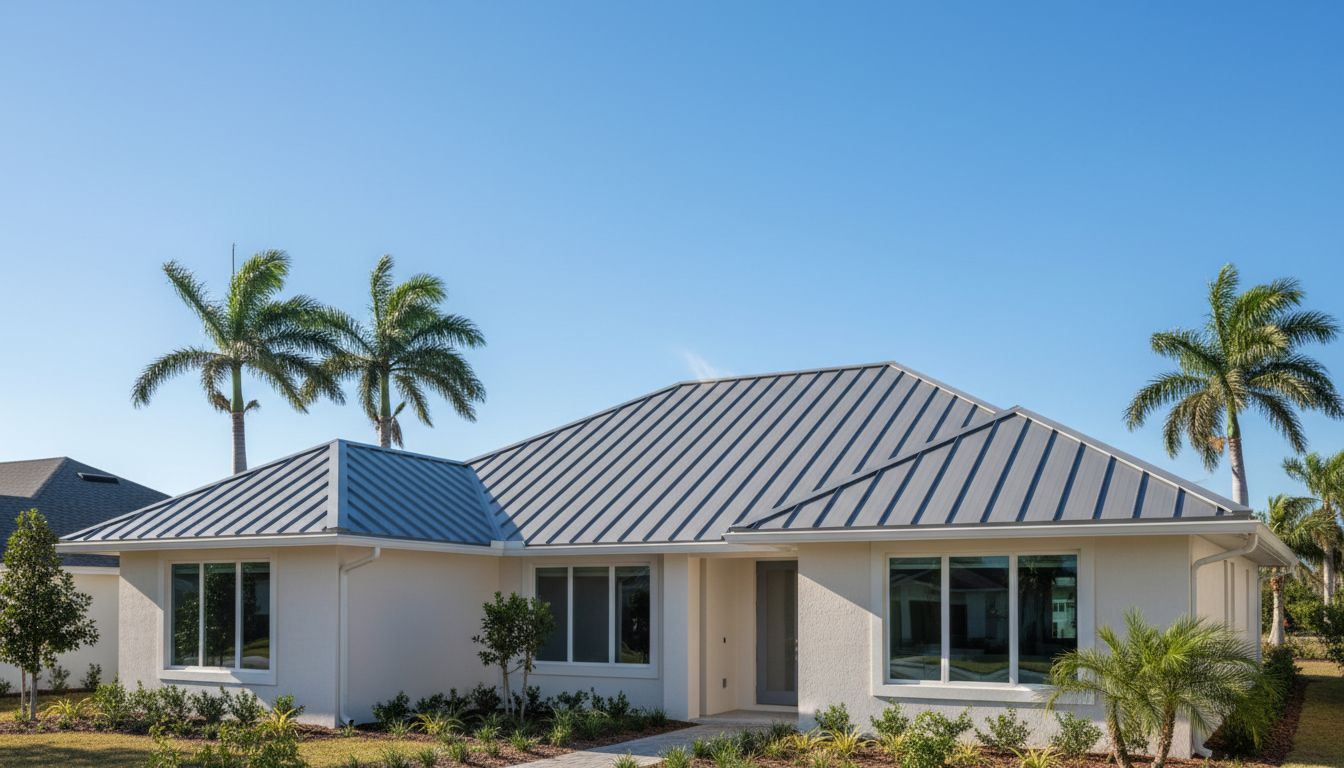
Florida sunshine is great for weekends, but it's tough on roofs. Metal panels can swing from cool morning temps to blistering surface heat in the same day. That constant expand and shrink cycle is metal roof thermal movement , and it's normal.
What isn't normal is when movement gets trapped. That's when you see fasteners wallow out, flashing split, panels "pop," or leaks show up around penetrations. The good news is you can plan for movement early, before panels are ordered and trim is bent.
This guide explains what moves, how much it moves, and how to detail Florida roofs so the metal can slide without tearing something apart.
Why Florida metal roofs move so much (and where the stress shows up)
Thermal movement happens everywhere, but Florida magnifies it. Strong sun heats the panel surface fast, especially on darker colors. Afternoon thunderstorms cool things down quickly. Coastal wind also pushes and vibrates panels while they're trying to move.
The key point is that the panel doesn't expand "outward" in a helpful way. It grows in length, and it wants to slide at clips, seams, and fasteners. When any detail locks it in place, the roof finds another way to move, usually by bending.
Here's where movement stress shows up first on Florida projects:
- Long panel runs : The longer the run, the more total change in length.
- Eave and ridge details : Drip edges, z-closures, and ridge caps can pinch panels.
- Wall transitions : Termination bars, counterflashing, and foam closures can trap the panel.
- Penetrations : Pipe boots and curbs fail early if they can't flex with the panel.
- Exposed-fastener fields : Screws and washers take the load when the panel can't float.
Code and approvals matter here too. Florida roof assemblies must meet wind and performance requirements, and details still need to allow the roof to move. For the roof assembly framework, see the Florida Building Code Chapter 15 provisions. For a plain-language explanation of how repeated heating and cooling affects roofing materials over time, this intro to thermal cycling is a helpful refresher.
If a metal roof can't move where it's supposed to, it'll move where you don't want it to.
Estimating panel movement (simple math, plus a quick table)
You don't need a lab to estimate movement. In the field, use this basic idea:
Change in length = (coefficient of expansion) × (length) × (temperature change)
Most Florida roofs should assume big swings at the panel surface. A conservative design check often uses a 100°F to 150°F swing, depending on color, ventilation, and exposure. If you want a reference list of typical expansion coefficients, use a table like the one in this thermal expansion resource.
Below is a quick "per 10 feet" planning table. Values are approximate and assume typical coefficients (steel 6.5×10⁻⁶, aluminum 12.9×10⁻⁶, copper 9.4×10⁻⁶ in/in/°F).
One sentence takeaway before you scan it: aluminum moves about twice as much as steel for the same run and temperature swing.
| Metal (typical) | Approx movement per 10 ft at 50°F swing | Approx movement per 10 ft at 100°F swing | Approx movement per 10 ft at 150°F swing |
|---|---|---|---|
| Steel (painted or metallic coated) | 0.039 in | 0.078 in | 0.117 in |
| Aluminum | 0.077 in | 0.155 in | 0.232 in |
| Copper | 0.056 in | 0.113 in | 0.169 in |
So what does that mean on a real Florida roof?
Example calculation for a long steel panel run
Imagine a 40-foot standing seam steel panel run installed on a mild morning, then it heats up hard.
- Pick a temperature swing : Use 120°F as a planning number (for example, 60°F morning to 180°F hot panel surface).
- Use the table to scale : Steel moves about 0.078 inches per 10 feet per 100°F.
- Adjust for 120°F : 0.078 × 1.2 = 0.0936 inches per 10 feet.
- Multiply by 4 (for 40 feet) : 0.0936 × 4 = 0.374 inches total movement .
If you design with a true fixed point, about half that movement goes each way. If your roof locks one end, the other end may need to absorb almost the full amount.
Attachment choices that make movement safe, not noisy
A metal roof should behave like a long ruler on a table. It can slide a little as it warms and cools, but it shouldn't bow, buckle, or rip the details around it. That behavior comes down to how you attach it.
Standing seam systems usually handle thermal movement best because clips can slide while the seam stays tight. Exposed-fastener panels can work well too, but they rely on fastener holes, washers, and correct screw placement to avoid binding.
In practice, plan around these movement-friendly concepts:
Fixed point vs floating field : Many standing seam layouts use a defined fixed point (often per manufacturer guidance), then allow clips to slide elsewhere. Without a plan, installers sometimes "accidentally" fix the panel at multiple spots, which creates stress.
Clip type and placement : Sliding clips exist for a reason. Clip spacing also ties into wind design, which matters across Florida. Match spacing to approvals and engineering, not habit.
Avoid pinching at trim : Hemmed edges, cleats, and closures should secure the panel without clamping it so tight it can't move. A tight closure that stops uplift but still allows sliding is the goal.
Fastener discipline on exposed-fastener roofs : Don't overdrive screws, don't miss the structure, and don't place fasteners where the panel needs to slip. Profile choice also affects how forgiving the roof is, which is why panel selection matters for each job. A quick comparison is covered in PBR vs Ag panel guidance for Central Florida projects.
When you're ready to map details, use manufacturer manuals as the main playbook. For Florida-focused references, keep the relevant metal roofing installation manuals close during layout.
Planning for movement at terminations and penetrations (where Florida leaks start)
Most callbacks tied to thermal movement happen at the edges and holes, not in the middle of the panel. Florida makes that worse because wind-driven rain looks for any small gap that opens during cycling.
Terminations: eaves, ridges, and walls
At eaves and ridges, the common mistake is building a "hard stop" out of trim. If a panel can't slide, it will oil can, push trim loose, or stress fasteners. Leave the correct slip space where the system requires it, and use the right closure strategy so you don't trade movement for water entry.
Low-slope roofs deserve extra attention because water moves slower and finds small openings faster. If your roof design is near the lower limit for a profile, confirm details and approvals early. This Central Florida minimum roof slope chart helps you line up panel type and pitch before you finalize trim and underlayment.
Penetrations: pipes, curbs, and skylights
Penetrations should flex with the roof. That usually means:
- Use boots and flashings intended for metal roofs , not generic parts.
- Allow for slip , often by using oversized holes with cover plates where appropriate, or by using flashing details that don't glue the panel to the penetration.
- Keep sealant joints where they can move , because rigid sealant beads tend to split when panels slide.
A simple field check helps: if you can't explain where the panel slides at a pipe, you probably trapped it.
Coastal and long-run safety notes (don't skip these)
High wind zones and very long panel runs can change the whole approach. In those cases, you may need engineered solutions such as expansion joints, specific clip systems, or segmented runs. For metal building roof framing context, MBMA publishes detailed technical guidance, see the MBMA Roof Framing Design Guide (2024 edition PDF). For a broader roofing standard reference used on many projects, the UFC roofing criteria (PDF) is also a useful baseline.
Always follow the panel manufacturer's instructions and Florida Product Approval requirements, and bring in an engineer when wind exposure, geometry, or run length calls for it.
Conclusion
Florida metal roofs move, every day, for the life of the roof. Planning for metal roof thermal movement isn't about guessing, it's about giving the panels a controlled place to slide and keeping terminations and penetrations flexible. Once you estimate movement and detail for it, the roof stays quieter, tighter, and easier to maintain. If you're planning long runs or coastal installs, treat manufacturer specs and engineering as part of the roofing material, not an add-on.
Share Our Metal Roofing News Articles
Related Posts