Backer Rod Use on Metal Roof Joints and Flashing Details
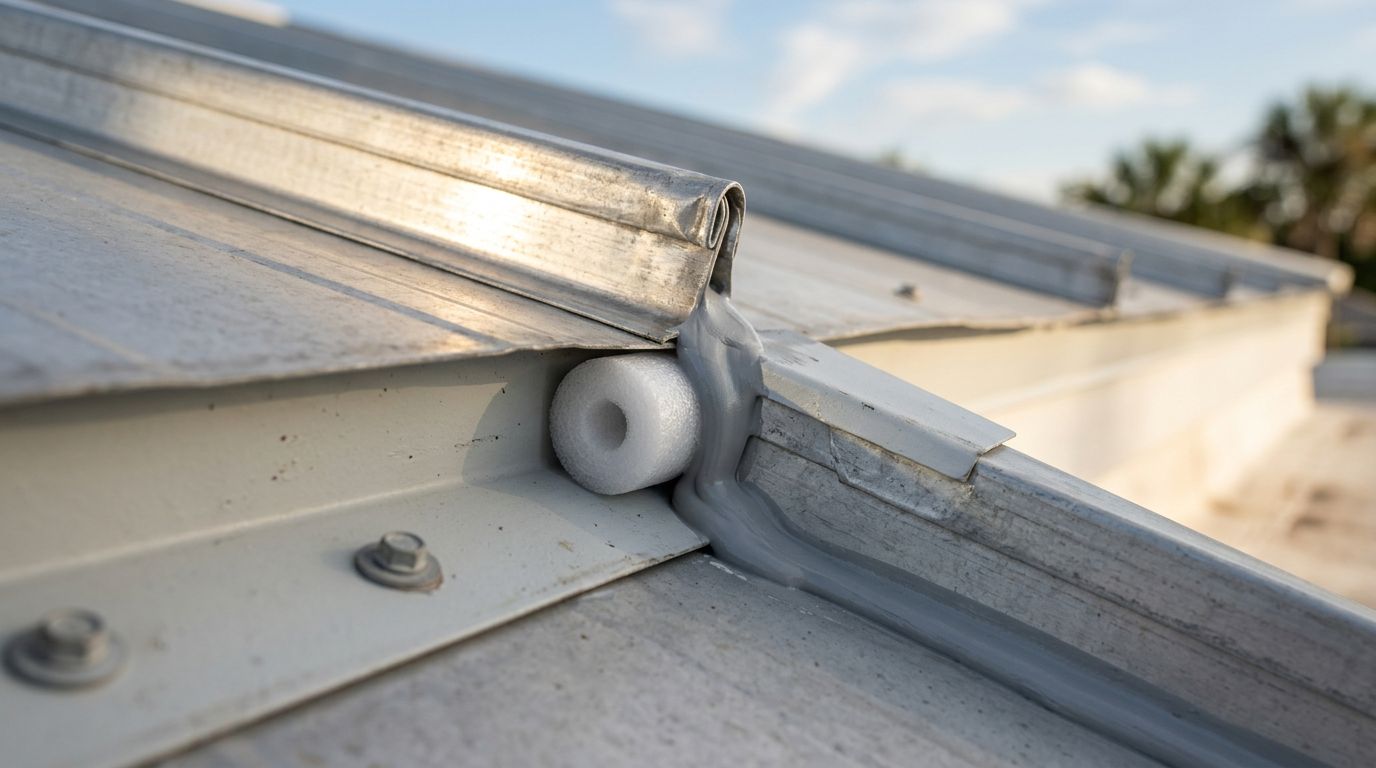
A small foam cord can decide whether a metal roof detail stays tight or starts leaking. In Florida, heat, wind-driven rain, and daily temperature swings push every joint hard, so backer rod matters more than many people think.
Used the right way, it helps sealant keep the right shape and depth. Used the wrong way, it can trap moisture, get overcompressed, or hide a bad detail that should have been fixed another way. That's why backer rod on a metal roof needs a real purpose, not just a place to fill.
What backer rod does in a metal roof joint
Backer rod gives sealant something to sit against. It controls the depth of the bead, helps form a clean joint, and keeps the sealant from bonding to the bottom of the gap.
That matters because sealant works best when it stretches from two sides, not three. When it sticks to the back of the joint too, movement puts more stress on the bead. The result can be early splitting, loss of adhesion, or water getting past the detail.
On metal roofing, movement is part of the job. Panels expand in the sun and contract after sunset. Flashing pieces shift a little too, especially around roof-to-wall transitions and terminations. Backer rod gives the sealant room to flex without being crushed into a thin, weak strip.
It also helps keep the joint looking clean. A sealant bead that is too deep often sags, sinks, or pulls away from the edges. A joint with proper support is easier to tool and easier to inspect.
Best places to use it on panels, flashing, and terminations
Backer rod works best where a joint is designed to receive sealant and has enough depth for proper support. That often includes end laps, flashing laps, wall transitions, pipe boots, curb details, and termination points where trim meets another surface.
It can also help at custom trim joints, especially when field conditions leave a wider-than-planned gap. That said, the gap still needs to be suitable for sealant. Backer rod is not a fix for sloppy fitment or missing flashing.
Details work better when they match the rest of the roof system, including trim, closures, and sealants. A guide to metal roof trim and flashing helps show how those parts fit together.
Use caution around panel side laps and other factory-designed joints. Many of those areas need closure strips, butyl tape, or a specific manufacturer detail instead of loose foam cord. If the detail relies on compression or a formed profile, backer rod may be the wrong choice.
Choosing the right size and foam type
Sizing matters more than most people expect. A rod that is too small falls out of place. A rod that is too large gets crushed and stops working the way it should.
The goal is a snug fit with controlled compression. The rod should stay in place without being jammed so hard that it loses shape. A good rule is simple, the sealant should be wider than it is deep, and the rod helps create that shape.
Here's a quick comparison of the two common types:
| Type | Best use | Main caution |
|---|---|---|
| Open-cell backer rod | Protected joints with limited exposure | Can absorb moisture if the joint gets wet |
| Closed-cell backer rod | Exposed roof details, flashing joints, Florida weather | Can be too rigid if the joint is undersized |
For most exposed metal roof work, closed-cell is the safer choice. It resists water better and holds its shape in hot weather. Open-cell can work in sheltered areas, but only when the sealant and detail are compatible.
Check the sealant label before you buy. Some sealants bond well to foam rods, while others can react badly with certain materials. The wrong pairing can shorten the life of the joint before the roof ever sees a storm.
How to install backer rod so sealant lasts
Good installation is simple, but it has to be clean. Dirt, dust, and trapped water undo good work fast.
- Clean the joint first. Remove old sealant, loose debris, and rust. The surfaces need to be dry and ready for adhesion.
- Pick the right diameter. Choose a rod that fits snugly without hard stuffing. If the rod buckles or tears during install, it's too large.
- Set the depth. Push the rod to the depth the detail needs, usually just below the sealant surface. Keep the bead supported, but don't bury it so deep that the sealant becomes too thick.
- Apply the sealant with care. Use a product approved for the roof metal, coating, and weather exposure. Tool the bead so water sheds off the top, not into the edge.
- Inspect the finished joint. Look for gaps, wrinkles, punctures, and spots where the rod shows through. A clean joint now is cheaper than a leak later.
A good joint has support behind the sealant. If the bead is too deep, it usually fails faster.
On metal roofing, a rushed install usually shows up at the first hot week or the first hard rain. That's why attention to joint depth and tooling matters more than speed.
Common mistakes that cause leaks or short service life
The biggest mistake is overcompression. When backer rod is forced into a tight space, it can push back and distort the sealant bead. That makes the joint harder to tool and easier to split.
Moisture trapping is another problem. Open-cell rod in an exposed detail can hold water where you do not want it. That is a bad fit for Florida roofs, where afternoon rain and humidity are part of daily life.
Improper sealant selection causes plenty of failures too. Some sealants skin over well but don't stretch enough for a moving joint. Others bond poorly to coated metal or to the rod itself. If the sealant and foam are not compatible, the joint starts weak.
A few other mistakes show up often:
- Using backer rod where a closure strip or formed flashing is needed instead.
- Stuffing the rod into a joint that is too wide for reliable sealant performance.
- Leaving dust, oil, or standing water on the metal before sealing.
- Covering damaged trim instead of replacing the bad piece.
Each of those issues points to the same lesson, backer rod supports a good detail, but it can't rescue a poor one.
When another closure detail is the better choice
Some joints should not get backer rod at all. If the opening is too large, the movement too high, or the water exposure too direct, a different detail is the smarter fix.
That can mean a custom flashing, a closure strip, a longer trim piece, or a formed termination that matches the panel profile. It can also mean reworking the detail so the gap disappears before sealant ever enters the picture.
Backer rod is best when the joint already makes sense and the sealant just needs help doing its job. It is not a substitute for proper trim design, and it is not a patch for missing metal.
For roof edges, wall terminations, pipe penetrations, and custom flashing lines, the detail should match the way water moves across the roof. If the joint still depends on heavy bead depth or constant movement, step back and reconsider the assembly. The right fix is usually simpler than layering on more sealant.
Conclusion
Backer rod is a small part of a metal roof, but it has a big effect on how a joint performs. It helps sealant keep the right depth, improves adhesion, and gives flashing details a better chance of lasting through heat and rain.
The key is to use it where the detail calls for it, size it correctly, and match it with a compatible sealant. When the gap is wrong or the water load is too high, a different closure or flashing detail is the better answer.
A well-built metal roof joint does not depend on luck. It depends on the right parts, set up the right way.
Share Our Metal Roofing News Articles
Related Posts